Southern Festival of Books

This weekend I went to the Southern Festival of Books in Nashville for a reading and it was lovely. For many reasons:

1.Incomparably beautiful drive across the Cumberland plateau where early fall was just beginning to paint the hills rolling away under a blue sky.
2. I shared a room with friends from Knoxville: Melissa Brenneman, Emily Dziuban and Elizabeth Gentry. Books and pajama party with wonderful friends, hard to beat.
3. My friends coddled my little fantasy of a drink in The Hermitage bar after the reading so I was happy.
4. Maybe 50 people at my reading, varied and attentive, good questions and I didn’t jumble too much. Sold some books.
5. I learned that Kit Carson spoke French, Spanish and about 8 Native American languages. A photographic recall of landscape but could not read or write English. Speaking so many languages did not stop him from pioneering the scorched earth tactics against native peoples that Sherman so ably employed at Atlanta. However, Carson did feel guilty later.
6. I heard Lee Martin read from his new book, Break the Skin and it was very very fine. I just started his The Bright Forever: the calm, sure stroke of a master. Really a gift.
7. I heard Ann Patchett speak passionately for independent booksellers.
8. I thought some more about my next book, which it turns out will be set in the 19th, not the 12th century. More on this later.
9. The Tennessee legislative halls, so often the cradle of repressive and misbegotten laws, was for three days the host of wonderful written word.
10. A Sunday morning radio preacher announced that he’s never seen a hearse with a U-Haul behind it. So I guess the message is: enjoy these fall days.

 

Tagged with:
Posted in WWWS

How to curse a book thief

I’m reading Stephen Greenblatt’s The Swerve, a fictive biography of Poggio Bracciolini, the great book-hunter, active circa 1417 and pictured here in cute bucket-cap. It’s an illuminating read.

In the very first chapter I found a useful suggestion. Did anybody ever “borrow” a book you love and then not return it? Just sort of forget? Don’t you hate that? Greenblatt shares a nice Renaissance curse for precisely this occasion: “For him that stealeth, or borroweth and returneth not, this book from its owner, let it change into a serpent in his hand and rend him. Let him be struck with palsy, and all his members blasted. Let him languish in pain, crying aloud for mercy, and let there be no surcease to his agony till he sing in disolution. Let bookworms gnaw his entrails in token of the Worm that dieth not, and when at last he goeth to his final punishment, let the flames of Hell consume him forever.”

Now all this may seem a tad harsh for a misplaced paperback, but recall that the curse pre-dates Gutenberg, so every book was hand copied and those illuminated manuscripts didn’t come cheap. Therefore we should make some judicious choices for our easier times: pick the hand-becomes-a-serpent switch OR the members-blasting palsy OR the entrail-gnawing worms. Any one of these will get your book-borrowing friend’s attention. However, you didn’t hear it from me.

Tagged with:
Posted in WWWS

Ebooks and wild sightings

I just heard from Amanda Bergeron, my indefatigable editor at HarperCollins, that When We Were Strangers has sold 3,100 ebooks, a record which she says means “confetti needed.” I’ve got none handy but tonight when our house fills up with local Italians and Italo-philes for our “Cinema Sotto Le Stelle” (cinema under the stars) home-made film festival with pot luck dinners and recent Italian releases shown on our deck, we’ll celebrate this.

But back to ebooks and writers, there’s the plus that the return is slightly more on ebooks than on “real” books (about 15 cents in my case). But there’s the minus that potential readers can’t read over someone’s shoulder or see the cover and ask if it’s a good book and (let’s hope) hear yes and go buy it. But the big deal for me is that there’s less chance in an ebook world for “sightings in the wild,” that electric moment when you are sitting at your gate at the airport and see someone actually reading your book, holding it in their hands, turning the pages, maybe (oh sheer delight) walking with it, reading. Naturally, there’s the down chance they toss it and pull out the National Enquirer, but still, you saw your work in a human hand. Now this probably happens to Stephen King every day, maybe even in checkout lines at the grocery, but the first time still must be something.

A friend told me she saw two (2) people in a Starbucks with When We Were Strangers, but darn, I don’t go to Starbucks. So I wait for my first “sighting in the wild” — seeing someone else following my Irma through her journey.

Tagged with:
Posted in WWWS

Revising “something”

I’ve been asked to do a workshop on revision for the local Friends of Literacy group. So I’ve been thinking of Revision Tactics I Have Used. I remember my first creative writing teacher, Miss Vincent, repeating: “You can always revise something. But you can’t revise nothing.” That has been a life line so many times. Just get something down!

When you’ve got something but it doesn’t seem to do what you want, when, as another teacher of mine said, “It’s not close enough to the bone, it doesn’t draw blood,” you might try:

1. Finish this sentence: The main point of this piece is .  . .

2. Put away what you’ve got. Get a fresh screen or piece of paper and rewrite the whole darn thing in 10 minutes of non-stop writing. If you go blank, just keep writing a character name or major image. Finish, shake out your hand and read what you wrote. Your mind may have taken you to the bedrock. In any case, you only invested 10 minutes, but more often than not, a window opens.

3. If the story is being told from the point of view of someone who is not the one with the most at stake, change the point of view to the one who does have the most at stake. “Friend of main character rarely works” unless, as in The Great Gatsby, Nick becomes the main character.

4. Try writing for 10 minutes straight from the antagonist’s point of view. See what you get. This may be uncomfortable, close to your own dark side, but you’ll see what you hadn’t seen before.

5. If the writing itself drags, try this. Print out a page. Highlight every form of “to be,” “to have,” or “to seem” when these appear as the principle verb of the sentence. For example: The elephant is large. He had no teeth. It seemed like summer in January. Revise each sentence using a verb with action. Get rid of “seeming.” Get rid of “looked like” too. This is an amazing process. As one mercenary student put it, “worth the price of tuition.”

6. Go in a quiet room, close the door and read your work aloud. What comes up? Where do you get tired of hearing your own words? Where did you pull back and not go to the bone?

7. And finally, most powerful of all, give your work to a good reader. Listen, just listen to the reactions. Don’t explain yourself. Don’t think “yet” how you’ll fix a problem. Just listen. It’s amazing. Where you once saw a wall, thinking, “this is the best I can do,” a door may open. It may not be easy to go through, but it will take you to a new room.

8. Limit the adjectives and adverbs. They’re way overrated. Go for the nouns and verbs.

9. Other ideas? What works for you?

Tagged with:
Posted in WWWS

Pie charts and crusts

One of joys of writing historical fiction is the researching of it. It was thus that I discovered which 19th C researcher popularized the pie chart. And who was that? While you imagine the “Wait, wait, don’t tell me!” sound effects, and ponder the hint to the left, I give you my friend Monique Doyle’s never-fail pie crust. I haven’t made it yet but have full faith. I botched my mother’s “never fail” but Monique assures me this is a whole other universe and as easy as you know what.

Monique’s Never Fail Pie Crust
2 cups flour
1 cup Crisco
(I combine the flour and Crisco before combining with milk mixture)
dash of salt
add 1 tablespoon apple cider vinegar to 1/3 cup milk.
Mix and roll out.

Now the answer . . . Florence Nightingale. She was a mathematician and statistician, taught largely by her father long before she took up nursing. The chart above was part of a convincing array of data which showed that more soldiers were dying in the filthy military hospitals of the Crimean War than on the battlefield. She helped change that. So think of her when you see a pie chart, and of Monique when you next make pie.

Tagged with:
Posted in WWWS

Food facts of the 1880’s

As Irma was moving west and discovering herself, our food technology was creeping along. I found a site which gives some of the advances of the 1880’s. Here’s an edited list, based on the unscientific principle of things most interesting to me.

1880 The first successful shipment of frozen mutton made it to London from Australia.
1880 One farmer out of every four was a tenant. Of gainfully employed persons, 49% worked in agriculture. There were 4 million farms in the U.S., averaging about 134 acres.
1880 Warren Glass Works patented the glass milk bottle.
1880 A.P. Abourne patented a method for refining coconut oil.
1880 Lydia Maria Francis Child died. An American abolitionist and author of novels and children’s books, she also wrote The Frugal Housewife (1829).
1880 The wholesale price of lobster was 10 cents per pound. (Lobster was the bothersome interloper in many fish nets, given to fishermen’s children for their lunches, when the children would have preferred bologna.)
1881 James Harvey Logan of Santa Cruz, California developed the Loganberry, a cross between a red raspberry and a wild blackberry.
1881 Edwing Houston and Elihu Thomson patented a centrifugal separator,  used in separating milk.
1881 The ice cream sundae was invented. Edward Berner of Two Rivers, Wisconsin, served a customer ice cream topped chocolate syrup (used to flavor ice cream sodas). It was a Sunday, and flavored soda water was not served on Sundays to respectable people. Remember this fact and please behave accordingly.
1881 Dr. Satori Kato of Japan introduced the first instant coffee at the Pan American World Fair.
1882 Swiss flour manufacturer Julius Maggi began commercial production of the first bouillon cubes, giving the poor a cheap way to make nutritious soup.
1883 First national gathering of cattlemen called by U.S. Commissioner of Agriculture, George Loring. The National Cattle Growers Association, was  established in 1884.
1883 Oscar F. Mayer & Bros. was established.
1883 Horlick developed the process to dehydrate milk, calling it Malted Milk, useful for babies and invalids. It could be shipped without spoiling.
1884 Willis Johnson of Cincinnati, Ohio patented his egg beater.
1884 L. Blue patented a hand corn sheller.
1884 Dr. John Harvey Kellogg applied for a patent for ‘flaked cereal’ (corn flakes). His brother Will Kieth Kellogg became rich by marketing the new cereal commercially.
1884 John Mayenberg, of St. Louis patented evaporated milk
1884 William Fruen of Minneapolis patented an automatic liquid vending machine.
1885 Good Housekeeping Magazine began publication.
1885 The Exchange Buffet opened, the first self service restaurant.
1885 Philadelphia brand cream cheese went on sale.
1885 Dr Pepper was invented in Waco, Texas. There is no period after the Dr in Dr Pepper.
1885 The first shipment of Florida grapefruit arrived in New York and Philadelphia.
1886 Automatic bottle filler and capper patented.
1886 California oranges first shipped East by rail.
1886 Coca-Cola was invented by pharmacist John Styth Pemberton at Jacob’s Pharmacy in Atlanta.
1886 Josephine Garis Cochran patented the first commercially successful dish washing machine. It became a huge hit at the 1893 Columbian Exposition. Her company evolved into KitchenAid.
1887 A livestock market opened in South St. Paul and sold 363 cattle on its first day.
1887 John Dickenson introduced paper napkins at his company’s  annual dinner.
1887 Asa Candler (1851-1929) a wholesale drugist, purchased the formula for Coca-Cola from John S. Pemberton an Atlanta pharmacist for $2,300. He sold the company in 1919 for $25 million.
1888 A patent for wax coated paper drinking straws (made by a spiral winding process) was issued to Marvin C. Stone of Washington, D.C.
1888 The first chewing gum to be sold in vending machines was made by Thomas Adams. He sold his gum in vending machines on elevated train station platforms in New York.
1888 The Manischewitz brand was founded in a small bakery built to make Passover matzo in Cincinnati.
1888 Refrigerated boxcars made first long-haul shipments of produce and meat.
1889 U.S. agricultural exports were about $574 million a year during the 1880s (76% of total exports).
1889 The word ‘hamburger’ first appeared in print in a Walla Walla, Washington newspaper.
1889 Dan Rylands patented a screw cap for bottles at the Hope Glass Works, Barnsley, Yorkshire, England.
1889 Aunt Jemima Pancake flour mix was introduced in St. Joseph, Missouri, the first self-rising flour for pancakes and the first ready-mix food ever to be introduced commercially.

What else? Let me know and I’ll add it to this list. Or make up something.

Tagged with:
Posted in WWWS

Corset curiosities

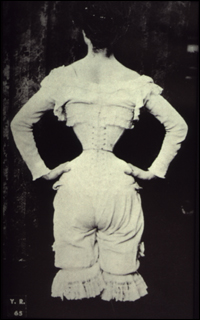
Corsets must rank with foot-binding in “not made by or for women” fashion history. But the search for wasp waists and swan-curve backs did call up the ingenuity of Victorian engineers – and some benighted attempts to make these armatures more healthy – or less devastating. Consider:

  • “Electric corsets” of the late 1870’s claimed to use the “healthy” effects of magnetic bands running up and down the body.
  • Dr. Gustave Jaeger’s Sanitary Woollen Corset of natural, undyed wool were reinforced with heavy cording rather than whalebone struts. Wool was better  for the skin said Dr. Jaeger.
  • The Edwardian swan or “S” curve forced the upper body forward and the hips back for balance, but at least did not constrict the ribs as mightily as the predecessor, “pinch the waist” corsets.
  • The clever corset/ bustle combination of the 1884 “New Phantom” affixed steel wires to a pivot which folded while sitting and zinged back into place when you stood up.
  • Not a corset but I can’t resist a promo of the Queen Victoria Golden Jubilee bustle with a music box that played “God Save the Queen” when derriere hit the chair.

No question corsets were deforming, painful, hot and unhealthy. These facts were well known at the time. Gwen Raverat’s Period Piece (1890) observes: “The ladies never seemed at ease…. For their dresses were always made too tight, and the bodices wrinkled laterally from the strain; and their stays showed in a sharp ledge across the middle of their backs. And in spite of whalebone, they were apt to bulge below the waist in front; for, poor dears, they were but human after all, and they had to expand somewhere.”

But some points of reality bear noting. The great mass of women in the 1880’s did not wear extreme corsets, or any corset at all. They worked on farms, shops,  factories or long hours at home. The wife of a New York City streetcar driver, working 14-16 hours for $1.75 a day, of which $4 per week went to rent, was not wearing the red sateen corset pictured here. The spoofers of the freakish wasp waist that leads this blog (and women like Sofia in my novel) had their way. By the turn of the century, corsets and bustles were old hat, so very 19th century.

And finally, those elegant period etchings of gentlewomen strolling in Central Park with their wasp waists and swan backs were no more representative  of the typical gentlewoman than the airbrushed, Photo Shopped models in glossy magazines resemble today’s young women strolling any street (or mall).


Sources:

Victoria and Albert Museum, “The secret history of the corset and crinoline” 

Such eternal delights


Tagged with:
Posted in WWWS

What is historical fiction anyway?

I’m preparing to give a workshop on research for writers generally and writers of historical fiction in particular. (Sept. 17, sponsored by the Knoxville Writers Guild). I got to wondering what this genre is anyway, I mean what do experts say about it? So I went to the best sources I know, my agent, Courtney Miller-Callihan of Sanford J. Greenburger Associates and editor Amanda Bergeron of HarperCollins. They generously wrote their take and said I could use their words here. I can’t imagine better descriptions of this rich, devilishly hard to write, but deeply rewarding (to me anyway) literary genre.

An agent’s view; Regarding a working definition of historical fiction, in the broadest of terms, it is a story set in World War II (or earlier) that’s written for a contemporary (now 21st c) readership, by a contemporary (now 21st c) author. Eventually that timeframe will get dialed forward to incorporate Vietnam, of course, but I think the idea is that it should not be a time period that most of the readers will have directly experienced. Good historical fiction offers a window to the past and allows the reader to feel that he or she is learning something about another time and place, but it also needs to feel modern enough to be accessible in terms of the issues it addresses and the stories it’s interested in telling. (We’re more interested in the Salem Witch Trials than in the nuanced religious and philosophical arguments the Puritans had about church doctrine; Calvinism is important but would probably make a pretty boring novel.)

An editor’s view: I think the best historical fiction authors are those who have done a tremendous amount of research, and yet the reader doesn’t walk away thinking “Wow, the author did so much research.” To be able to write about a time or place it’s crucial to fully understand what you’re writing about so that the characters and scenes leap from the page. To that end, I look for projects that are atmospheric, feel authentic, and tell stories full of rich, lively, engaging characters. The best fiction touches on universal themes, and so I find that the most successful historical fiction projects bring the past to life through ideas and emotions that are just as real now. But to be able to write great fiction in a way that feels natural, it is necessary for the reader to feel confident in the writer and writing. The second something unbelievable or anachronistic occurs, it’s a distraction that takes credibility away from the story and author. For those reasons alone it’s so important that an author become a bit of an authority on their subject (or at least know exactly where they can find what they need). At the same time, it’s never fun to read something that feels bloated with research to the point that it gets in the way of a story.  Bottom line: great storytellers use research as a foundation for their characters and story but nimbly avoid getting tangled up in it.

Tagged with:
Posted in WWWS

Workingman’s neck

Labor Sunday, Sept. 4.

Long before I knew the term “red neck,” I was fascinated by my grandfather’s neck. It was reddish, with deep groves in diamonds that grew deeper when he turned his head. He’d lived in the sun, mostly in the South. He grew up on an Iowa farm, worked relentlessly by his father. Once in a bar in De Witt, my grandfather caught sight of an actual twenty dollar bill (this was some time ago) flashed by a traveler who’d gotten it roughnecking in the Texas oil fields. My grandfather high-tailed to Texas, where he shared a room, old car and one good suit of clothes with a friend. When the Depression hit, my grandfather was married with three children. Under a New Deal plan, he got title to a little farm outside Houston with $200 his mother somehow scrapped together.

There he worked, the kids and my grandmother worked, he delivered the Houston Chronicle, milk and eggs. His neck grew diamonds. When the kids married and went away and my grandmother died, he paid cash for a little duplex in a modest neighborhood with a yard for gardening.

At the funeral, my father wasn’t surprised to see a small gathering. My grandfather was 94, after all. But among the church ladies and old friends was a young Mexican woman, one of my grandfather’s neighbors. Her income covered the bare minimum for herself and her children, rice, beans, bread. Then bags of vegetables began mysteriously appearing on her porch before dawn. One night she waited up and nabbed my grandfather, who sheepishly begged understanding. “I’m an old man,” he said, “I plant too much in the spring. Maybe you can help me out.” He was 92 at the time, still a working man, his neck full of diamonds.

Tagged with:
Posted in Just life

Hurricanes and Gingkos

Back when I was a child in Metuchen, New Jersey, hurricanes passed by with some regularity. One came just after my father had planted twin gingko trees in our front yard. While he was normally quite fastidious in tree-planting, for some reason he had neglected to stake these two. That night, as the worst of the hurricane passed, he watched with rising upset as his gingkos tossed and bent nearly to the ground.

“We could lose them if the wind keeps up,” he fretted. My mother was unmoved, not caring overmuch about trees. Imagine her alarm when he appeared at the front door in a raincoat, armed with rope, stakes and a mallet.

“You’re crazy!” she yelled over the storm. “You want to leave three children fatherless for a couple ginkos?” I peered into the black, driving rain. They did look a little insignificant — and replaceable.

Wild shrieks filled the living room as my father shouldered the storm door open. This was thrilling, really. Imagine wind as strong as my father, pretty much the strongest man on earth, I thought in those days.  He staggered across the yard as my mother kept up a litany of observations regarding his mental state. I watched, terrified and fascinated as he roped down the wildly bucking trees. Would I be fatherless that night? Still, what a story: “So how did he die?” kids would ask forever after. “Saving our gingko trees.”

Happily, both the trees and my father survived the storm and grew to stately age. Fast forward to Hurricane Irene. In Manayunk, PA, police arrest two men for rafting down the main street on a charge of “lack of common sense.” If the Metuchen police had been equally diligent, my father would have been locked up that night. As it was, we had ice cream and it could be that my mother was secretly proud of him.

Tagged with:
Posted in WWWS
Recent Review
“Absorbing and layered with rich historical details, in Under the Same Blue Sky, Schoenewaldt weaves a tender and at times, heartbreaking story about German-Americans during World War I. With remarkable compassion, the author skillfully portrays conflicted loyalties, the search for belonging, the cruelty of war, and the resilience of the human spirit.”—Ann Weisgarber, author of The Promise and The Personal History of Rachel Dupree

Enter your email address to subscribe to this blog and receive notifications of new posts.

Join 122 other subscribers