
 In the years that I lived in Naples, one of the most beautiful scenes took place on Thursday nights in the summer. Imagine. It’s perhaps 10 o’clock, still warm, with a breeze from the Bay. The Castel Nuovo (the “new castle,” built in 1279 by King Charles I), rises near the water, with a lush green lawn on the west side. It’s lit by floodlights, making the grass a deep Kodachrome green. Thursdays are always the night off for the African women who are, mostly, babysitters, for rich families. They gather on the Castle lawn, wearing vivid robes and headdresses, a garden of queens and princesses. African men come too, in Western dress. There are more men than women and they cluster around the women, pleasant, smiling, respectful, paying court. A wind comes up, lifting the bright robes that stream behind the women. And in the background, the somber, serene turrets of a medieval castle that has stood for nearly 800 years and now graciously hosts this beautiful scene.
African queens in Naples
The four nights of meatloaf
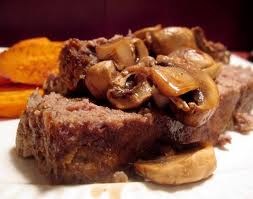 My mother grew up in the Depression on a small farm on a plot of land now absorbed into Houston. She was by long habit frugal with family food and given to meticulous planning, even if my father’s income no longer required these precautions. Hence the four nights of meatloaf.
First night: Fresh from the oven, the new meatloaf was deliciously juicy, the aroma sweetly filling the air, calling us from our rooms. Usually there was sauce (Campbell’s Cream of Mushroom). The meatloaf was melting-soft and comforting, with hidden sparks of onion, celery, sometimes bright specks of carrots. If not a meal for kings, at least princes. Always mashed potatoes too, a warm mound with a tiny golden pond of melting margarine.
Second night: Reheated meatloaf. Sometimes not reheated, but simply there on the plate, quite dense now, more brittle than tender, with a gray-brown tinge. Dull flecks of vegetables whose tastes had dimmed beyond detection. The mushroom sauce would be finished, replaced by catsup’s slightly-tomato taste covering bland slightly-meat memory. Lunch would have been meatloaf as well, slightly moister, between two slices of white bread. So here was a replay of the replay.
Third night: Spaghetti with meat sauce. Crumbled up meatloaf in canned tomato sauce. A new lease for the meatloaf, now quite dry but at least tomato-infused back to softness, if not to the now lost and forgotten meat taste. The pasta could be twirled, at least, so that was a diversion.
Fourth night: Warmed over spaghetti with meat sauce. The pasta chopped. Now the sauce was merely lumps which could easily have been chunks of dry bread. “Finish your dinner or no dessert.”
It’s a gray day. The Martin Luther King March this morning was cold and long, with bright, warm spots of groups along the road handing out cookies and hot chocolate and cheer. I’m thinking of meat loaf — the sweetness of the first night.
Writing from a small city
 Not quite the NYT Bestseller list, but When We Were Strangers made the list at Knoxville’s Union Avenue Books, our local and very fine independent. Here’s the list, FYI:
Celebrating Our Favorite Local Authors and Special Friends Who Ranked Among the Top 25 Bestsellers at Union Ave in 2011
Michael Knight, The Typist
Pamela Schoenewaldt, When We Were Strangers
Hugh Acheson, A New Turn in the South
Ros Taylor, Confidence at Work
Jack Neely, Market Square: A History
Bill Landry, Appalachian Tales
Norma Watkins, The Last Resort
Bobbie Ann Mason, Girl in the Blue Beret
Amy Greene, Bloodroot
Jake B. Morrill, Randy Bradley
Susan Gilmore, Improper Life of Bezellia Grove
Knoxville has a thriving writers community and a great support group, the Knoxville Writers Guild. We’re a small city, 179,000 souls as of 2011. And for debut writers, this is an advantage, according to my agent, Courtney Miller-Callihan. Why?
First because in a small city there is still enough home town pride and press if a local anybody gets noticed on the outside. There are also enough readers, book clubs, fellow writers and civic groups who want speakers to get a little traction in sales. Then these people may have reader friends elsewhere. Book sales can grow organically through book clubs and in a city our size, people in clubs tend to find each other out,
In a small town, however, a writer soon exhausts the universe of potential readers, even with the home town advantage. There just aren’t that many people to recommend your book elsewhere if there isn’t a marketing push from the publisher, which, statistically, there probably isn’t. In a big city, there are bound to be some literary heavyweights and it’s hard to get noticed without a pr machine at your service or really terrific reviews. Of course to be the buzz in the Big Apple is one very huge buzz, and if you can make it there, you can make it anywhere (as we know) but how often does this happen to the debut novelist?
Naturally, there are a zillion (well many, many) exceptions to this theory but still, worth considering if you are footloose with a laptop.
Dangers of devouring books
 If you read this blog, probably you were an eager reader of books as a child. Perhaps you even “devoured” them. I came upon this 1835 article from the American Annals of Education and quote in full, so that you may be WARNED of the gluttony of over-reading and the UNIVERSAL LAW you may have transgressed in childish ignorance. Please, prudence in all things.
DEVOURING BOOKS, from the American Annals of Education, January 1835, pp. 30-32)
It is recorded of Madame de Stael Holstein, that before she was fifteen years of age, she had ‘devoured‘ 600 novels in three months; so that she must have read more than six a day upon an average. Louis XVI., during the five months and seven days of his imprisonment, immediately preceding his death, read 157 volumes, or one a day.
If this species of gluttony is pardonable in circumstances like those of Louis, it is less so in a young lady of fourteen or fifteen. No one can have time for reflection, who reads at this rapid rate. And whatever may be thought, these devourers of books are guilty of abusing nature, to an extent as much greater than those who overcharge their stomachs, as the intellectual powers are higher than the animal propensities.
If we find but few cases of mental gluttony equal to that of M. de Stael, there are many which fall but little short of it. Thousands of young people spend their time in perpetual reading, or rather in devouring books. It is true, the food is light; but it occupies the mental faculties, for the time, in fruitless efforts, and operates to exclude food of a better quality.
I should be among the last to engage in an indiscriminate warfare against reading, but when I see the rapid increase of books in our market, and their general character, and consider, that the condition of the market indicates the character and strength of the demand, when to this is added the conviction forced upon us, by facts within the range of daily observation, I cannot resist the conclusion, that it strongly behoves those who are friendly to mental as well as physical temperance, to sound an appropriate alarm.
Perpetual reading inevitably operates to exclude thought, and in the youthful mind to stint the opening mental faculties, by favoring unequal development. It is apt either to exclude social enjoyment, or render the conversation frivolous and unimportant; for to make any useful reflections, while the mind is on the gallop, is nearly out of the question; and if no useful reflections are made during the hours of reading, they cannot of course be retailed in the social circle. Besides, it leads to a neglect of domestic and other labors. The law, that ‘man shall eat bread in the sweat of his face,’ is not to be violated by half or three fourths of the human race with impunity. It is a UNIVERSAL LAW; and that individual, let the sex, rank or station be what it may, who transgresses, must suffer the penalty–not mere poverty, but a loss of actual enjoyment, if not of health. Even if we do not intrude upon the hours sacred to repose, sleep becomes disturbed, unsound and unsatisfying. Food loses its relish, life its zest, and instead of seeing the fair and goodly Eden we read and dream of, the world becomes less and less interesting, and we actually begin to complain of our Creator, while the fault is in ourselves.
Such, are some of the results of a perpetual devouring of books; but it would require a volume to state them all in detail, so as to show the full extent of the evil.
I am fully aware that the error in question favors book-makers and booksellers; for ‘it is an ill wind that blows nobody good;’ but this should not prevent our protesting against it. And while I disclaim all fellowship with those who derive no pleasure in the contemplation of the future, but place the golden era among past ages, I do not hesitate to say, that our ancestors, at periods not very remote, were more truly wise than the children of this generation. If they read fewer novels and light periodicals, they meditated more on those they read. If they had fewer books in the community, they had more of what Locke calls, sound, round-about sense. If they devoured less, they digested more. It has been said of Dr. Johnson, that giant in real literature, that he never read a book through, except the Bible.
How would our mental gormandizers scout the idea, suggested by one who passes for wise, that we should always read with a pen in our hand! How would Madame de Stael have smiled, at being told that she would probably derive more benefit from reading half a dozen pages in a day, than the same number of volumes!
But we may anticipate a better future. This book-mania is destined to pass away. There is–there must be–in a world which has been for thousands of years improving, too much good sense long to tolerate it. Let the present race of youth, of both sexes, continue to devour greedily every catchpenny publication that issues from the teeming press. But let them remember, that they are unconsciously hastening themselves from life’s scenes, to give place to other, and we hope more rational actors–those who will remember that neither their mental or physical natures can be sustained by mere gormandizing, and that digestion is no less important than mastication.
Dangers of Italian wind
 It always struck me as strange that for a coastal city, wind was considered such a mortal risk in Naples. I’m not talking about howling winds, tornado winds or hurricane winds. I mean breezes that might just flutter summer leaves. Careful mothers in the south would not bring out a bundled baby in such conditions. What would people say?
Such wind could give a healthy child bronchitis or pneumonia in a flash, I heard over and over. God forbid wind on the stomach. No end of the trouble. I woke up once with one eye bright red from a burst blood vessel. The doctor’s first question: “Were you in wind?”
On boiling hot nights when a fan (I thought) would be so nice, maybe an overhead fan, my neighbors recoiled in horror. Wind on your face at night? Wind on the stomach? Don’t risk it. Wind when you’re sweating? That leads straight to chills and their natural sequelae: bronchitis, pneumonia and early death. Thus the oft-heard admonition to children running about in parks in the summer: “Don’t run. Don’t sweat.” You wonder how so many boys survived to be superb soccer players.
All this wind phobia reminded me of The Secret Garden. Remember Mary Lennox at the start of that wonderful book? Thin, sallow, unpleasant, contrary, selfish. What fixed her right up, brought color to her face, gave her appetite, improved her mind and disposition, even thickened her hair? Brisk Yorkshire wind and plenty of it. Globalization might bring depressing similarity to grocery stores of Yorkshire and Naples, but living with wind is quite a local matter.
Italian at the train station
 Aside from native born Americans and some tribal peoples, most of the world is bilingual. I studied a few languages at school in a desultory way, but it wasn’t until 1990 when I moved to Italy that fluency took on a certain urgency. I think one tends to remember the first foreign communication triumphs, like the first time I asked for an eggplant and (amazing) was handed one.
Or the time I paid for a ticket on the Cumana, the local commuter line, a few weeks into my stay. Tickets then were flimsy slips of paper and with wallet and pockets I suddenly couldn’t find mine. “I gave it to you,” the clerk said, but checked her counter obligingly. “Oh, here it is, in my pocket,” I said. She wished me good day and I left the counter. OK, not a thrilling interchange but I realized with stunned delight that I had actually used the direct object pronoun! And the right gender (biglietto — ticket — is male [of course])! Did she notice? Should I go back and remind her? I didn’t, but it was happy moment.
Soon after, on a rainy winter day, I was buying an inter-city ticket at the downtown station, open to the street, and couldn’t get up to the counter because a large wet stray dog was huddled against the wall. Not knowing what insect life inhabited the fur, I called to the agent, a meter away, “One round trip to Rome.”
“Come to the counter, Signorina.”
“I can’t, there’s a wet dog here.”
“A what?”
“A wet dog.” I pointed. With a “These foreigners!” sigh, he left his post, came around to my side and looked down where I pointed.
“It’s a wet dog,” he announced. I agreed. He shooed the dog away. “Might have fleas. You shouldn’t get too close,” he said. I agreed. My first extended exchange with a ticket agent.
Soldier coming home
 The happy news of the end of the Iraq War reminds me of a scene a few summers ago at the Knoxville airport. I was coming to pick up Maurizio, parked in the short term lot and followed a pretty young mother and two small children up to the arrivals gate. Mother and daughter wore matching pastels; the little boy’s clothes were equally crispy new. All three were freshly coifed. They seemed happy but each one absorbed, barely speaking. “Their soldier’s coming home,” I guessed.
We assembled with a clutch of waiting people a discrete distance from the “passengers only beyond this line” sign. Maurizio’s flight was late, so I watched for theirs. And there he was: a young man in uniform pushing through the revolving gate with a backpack and manila envelope. From years of teaching at a base in Naples, I knew the envelope held his PCS (permanent change of station) orders which must be affixed to the soldier during transit. After so much waiting, the family seemed stunned motionless by his sudden appearance. He sprinted toward them. At the “passengers only” sign, he dropped pack and envelope, fell to his knees and slid the rest of the way, arms open towards the running children.
Welcome home to all those returning.
What was cooking in 1900?
 What was on the table in the early 1900s? And what about way before that? I found a great timeline of food history. Here is an excerpt from the era of my novel, 1900-1911: cook books, PB&J, and the rise of Jell-o.
1900—Banbury tarts, The Stonington Cookbook, CT
1900—Enterprising Housekeeper, Pan-American Exhibition
1900— Food for the Sick and How to Prepare It, Edwin French
1901—Pan American Cookbook and peanut butter & jelly
1901—Settlement Cook Book, Mrs. Simon Kander
1902—Devil’s food cake and animal crackers
1902—Mrs. Rorer’s New Cook Book, Sarah Tyson Rorer
1903—cranberry bread and canned tuna
1903—U.S. Senate Bean Soup & Club sandwiches
1904—Dr. Price’s Delicious Desserts banana splits and Ovaltine
1904—Cooking in Old Creole Days, Celestine Eustis
1904—Blue Grass Cook Book, Minnie Fox [Kentucky cookery]
1905— Los Angeles Times Cook Book and New York pizza
1905—Lady Baltimore & Checkerboard cakes
1905—submarine sandwiches
1905—Tomato gravy & Tamale pie
1905— Finnish-American Cookbook, Kaleva Michigan (with English translation)
1906—brownies & banana cream pie Kellog’s Corn Flakes, Taylor Pork Rolls
1906—Harvard beets & Muffoletta sandwiches
1906—Refugee’s Cook Book, (San Francisco earthquake)
1907—Le Guide Culinaire/Escoffer (English)
1907— Divinity fudge & sauerkraut candy
1907—aioli
1908—Steak Diane & Lobster fra diavolo, Meyer lemons
1908—buttercream frosting
1909—Good Housekeeping Woman’s Home Cookbook,
1909—Reform Cookery Book, Mrs. Mill
1909—shrimp cocktail
1910s—Jell-O: America’s most famous dessert
1910—Home Helps: A Pure Food Cook Book
1910—Chipped beef, Manual for Army Cooks
1911—Apple sauce cake
1911—Good Things to Eat, Rufus Estes
1911— Paper Bag Cook Book
1911—Catering for Special Occasions, Fannie Merritt Farmer
1911—Kitchen Encyclopedia, Swift & Company
The “new land” revision exercise
 This week I gave a workshop on revision for the Knoxville chapter of Friends of Literacy. Here’s one of our exercises. Often in fiction (or non-fiction) characters enter a “new land,” sometimes literally, but often simply a radically new situation. This exercise helps you unlock the potential of the “new land.” It’s fast and fun and may lead to profitable revisions. If it helps you, let me know! I’ll be posting other revision exercises.
IN A STRANGE LAND: You (or your character) leaves a familiar place. Old skills, connections and knowledge don’t help. Answer quickly. Notice that the exercise starts with sensory reality and moves to emotional reality. Don’t overthink your answers. There’s time for that later.
1. I (s/he) was a stranger in a strange land when . . .
2. I (s/he) looked around and saw . . .
3. and heard . . . .
4. and felt/tasted/smelled . . .
5. and remembered . . .
6. and was afraid (or excited) because . . . .
7. and more than anything wanted, needed . . .
8. usually, I/he/she would have . . . . .but this time, I discovered . . . .
9. I/he/she felt so . . . .
10. one comfort, one hope or strength was that . . .
11. I/he/she I decided to . . . .
12. and then . . .
Women’s work, 1911
 Around 1911, the period of my novel in progress, women in factories generally earned 50-60% of men’s salaries. More than a century later, we are at 77% in factory and non-factory careers. Not much progress. Employers then often paid half of even these depressed wages for a season or more as women were “learning,” even if the job was so menial than little learning was required. Of course now we have unpaid “internships,” so that’s much, much different. . .
A work in a New York cap factory stated: “By working hard we could make an average of about $5 a week. We would have made more but had to provide our own machines, which cost us $45. We are paying for them on the installment plan.” When the factory burned, which was common, those who had somehow paid for their machines had to start all over again. Prices for working women were further depressed by wages for “home work” done at slave wages.
As most employers stated, since women “should” be married, there was no reason for pay equity. Besides, said one investigator, the typical worker “has no definite idea of the value of her services; the first place she goes to, if she is repulsed, she is willing to ask for less at the next.”
 pamelaschoenewaldt.com