Fridays in Florala

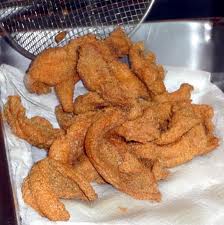
Some Friday if you find yourself near Florala, on the (get it?) border of Florida and Alabama, you could do worse than stop at Sara’s Big R, “Southern Cooking at its Best,” for the Friday seafood buffet. For $11, heap your plate. First of course the fried offerings: shrimp, catfish, chicken (a sort of fish, apparently), stuffed crab, hush puppies and fried summer squash so sweet it seems a fruit. Then the creams and mashed: potatoes, cauliflower, corn, rutabaga, corn grits. There’s beans, corn, corn on the cob, spinach and greens, green beans. Then the salads: corn and corn salad, pickles, huge tomato slices, hard boiled eggs, relishes, canned fruit (of course), cottage cheese, bean salad, potato salad, more, more salads. A sort of pudding cake we didn’t try. Go back for refills (Maurizio did). All good. Southern cooking at its best, just like Sara says.

I believe it was Sara herself whom we saw when we came in, talking to an older gentleman who suffered from reduced lucidity and mobility. He was going on at some length about his troubles. Sara leaned close to hear him and said several times: “Hon, you just tell me what you need and I’ll do it.” Our waitress, a teenager who loves basketball and hates computers (“I bet you never heard a teenager say that”) means to go to community college for her associates, then U. of Florida to begin her journey to ob-gyn. “It’s what I always wanted.” I’m sure she’ll get it.

We’d been looking for some time for a place to eat and put off by the last few establishments’ odd couplings: “Chainsaws and hot dogs,” said one. “Milk shakes. American owned.” Then you find Florala, a lovely little town of deep porches, huge trees and a wide, wide lake of the state park. Stop at Sara’s Big R. You’ll be glad you did.

 

Tagged with:
Posted in WWWS

What about those parties?

I was talking to a neighbor who’d been talking to her neighbor whose backyard has a partial view of ours. She (the second neighbor) was complaining about “that gay couple with the drunken hot tub parties.” Now that could only be us, that is my husband and me. As it happens we are quite unaware that we’re gay and have not attended any, not even one, drunken hot tub party in our own back yard.

We fly the Italian peace flag (“pace” being Italian for “peace”). And we  have a hot tub. She must  think we have modified the rainbow flag with a reminder to pace out our debaucheries. The distressing thing is that while we try to be sociable and really do have a fair number of gatherings here, nobody has invited us to these drunken bashes. Most of our festivities (the ones we’ve attended) are fairly tranquil. Now we’ve drained the hot tub for the summer and where will our fictive friends go? What will they do? What will our neighbor’s neighbor do when all there is to watch in our backyard is zucchini and tomatoes growing and peaches ripening, waiting for squirrels to eat them?

Tagged with:
Posted in WWWS

Here’s to the paraprosdokians

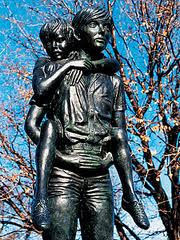
Somewhat convoluted start to this blog. I’ll be doing some interviews for work of young boys who have brothers in their school, which got me thinking of the song and the line: “He ain’t heavy, he’s my brother,” then remembering a very moving essay by a young girl about the care she willingly took of her brother who had various severe handicaps.

Then, being of a writerly mind, I got curious about the phrase itself. Just now, when I should be novel-writing, I poked around and discovered that “He ain’t heavy, he’s my brother” is an example (as you all doubtless know) of the figure of speech called the paraprosdokian: a structure in which the second part of the line invites re-interpretation of the first part.

The indefatigable Wikipedia offers us time-wasters other examples of the paraprosdokian:

He was at his best when the going was good.” —Alistair Cooke on the Duke of Windsor

You can always count on the Americans to do the right thing—after they have tried everything else.” — Winston Churchill

“A modest man, who has much to be modest about.” — again (reputedly) Winston Churchill

I’ve had a perfectly wonderful evening, but this wasn’t it.” — Groucho Marx

“She looks as though she’s been poured into her clothes, and forgot to say ‘when’.” — P.G Wodehouse 

Do you have any paraprosdokians to share so we can all waste more time in harmless enjoyment of the English language?

Posted in WWWS

Brainworkers’ disease

I’m researching, among other things, treatment of the insane circa 1910. A particular malady was emerging then among “brainworkers.” It was the price of civilization, apparently, and particularly afflicted the professional class. The malady was called neurasthenia. The symptoms, as listed by neurologist George Miller Beard, included, get ready (and I’ve shorted the list):

Tenderness of the scalp and spine . . . teeth and gums, tenderness of the whole body, general or local itching, vague pains and flying neuralgias, tremulous and variable pulse, special idiosyncrasies in regard to food, medicine, and external irritants, sensitivities to changes in the weather, profound exhaustion unaccompanied by pain, ticklishness, desire for stimulants and narcotics, partial failure of memory, mental depression and general timidity, morbid fears of special kinds, as agoraphobia and aacraphobia [fear of lightening], sick headache, disturbances of the nerves and organs of special senses, local chills and flashes.

And so forth. One solution, recommended by Dr. John Harvey Kellogg of Battle Creek Sanitarium, was to eat a lot of cereals, especially granola or, better yet, his new corn flakes. I myself will continue eating granola in the morning.

Posted in New novel

Writing with a dog

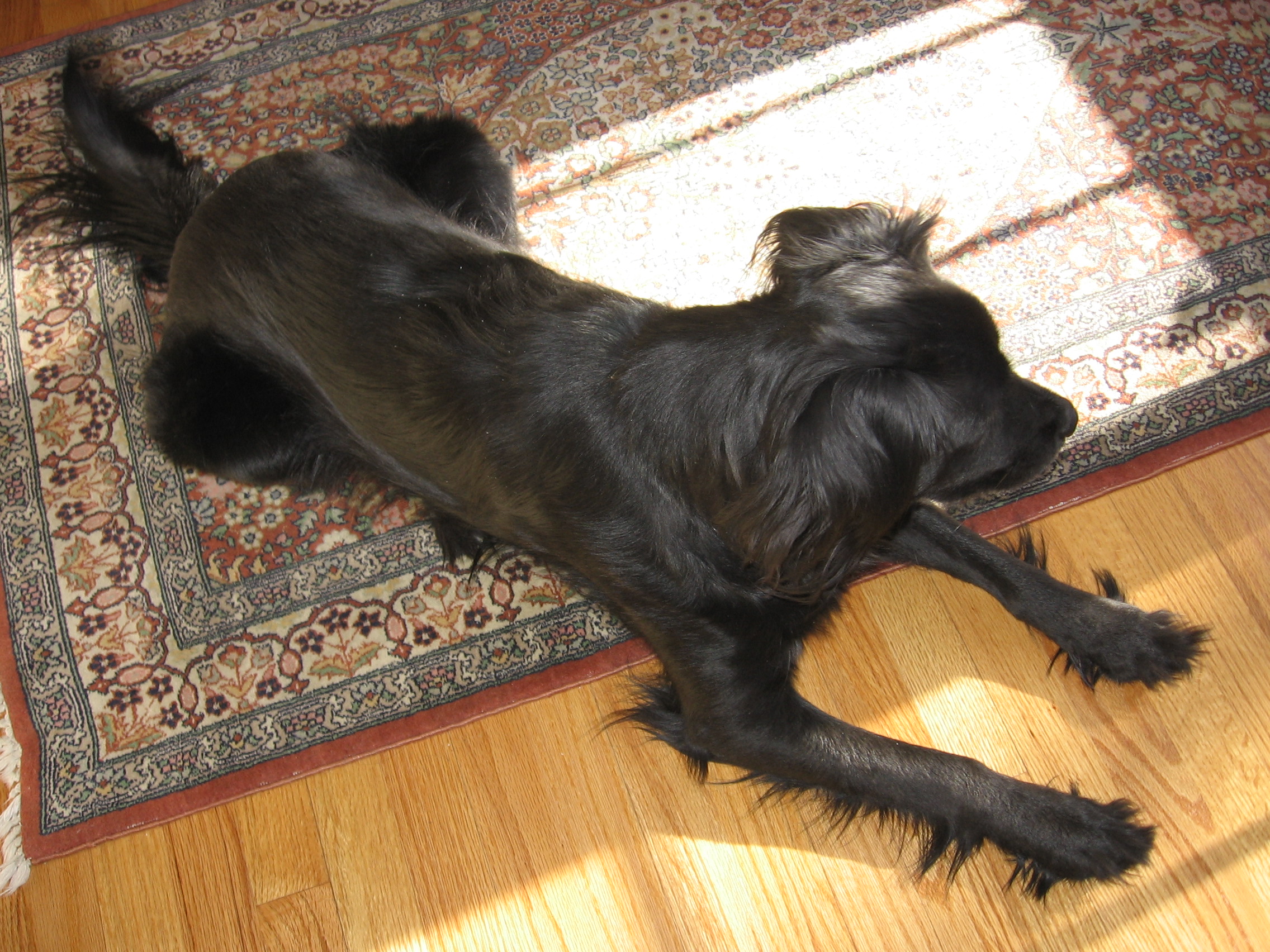
A good and patient, caretaking dog helps in novel writing I believe. Jesse the dog normally sleeps in a small bed by the foot of our bed. But on nights when I’m up late writing, he won’t officially retire with Maurizio, but stations himself in the hall just outside my study. He seems to be sleeping but is ever attentive to certain sounds. The “shut down” Word command, the pushing in of the keyboard tray, my standing and stretching and the apparently particular sound of the chair wheels when this happens.

He’s on his feet by the time I turn out the light and leads me, or so it seems, to the kitchen. He looks in, looks up, ever hopeful. The message, I believe, is that even in our largely vegetarian household I just might feel moved to cook up a large midnight steak and give it to him. Could happen. It never does, but he always stops at the kitchen. He takes me to the front door so he can take  his toilette among the perennials. Then, constantly looking back to make sure I’m following, he leads the way upstairs and to our respective beds. Whether the day’s output was a hundred or a thousand words, or only the polishing of extant phrases, Jesse brings a comforting closure.

Tagged with:
Posted in WWWS

Twilight Zone on Hiawatha Street

I often walk Jesse the Dog on Hiawatha Street, a winding, tree-lined suburban street, not much traveled. On a 15 minute walk a couple cars may pass or none, if it’s early. This is good because Jesse prefers to walk without a leash. Leashes offend his dignity, so I carry one to appease the fair city of Knoxville, but rarely apply it. To the point. Saturday morning, a quiet cool day, about 9 a.m,, only Jesse and I were up and about, Jesse sniffing, me musing on Chapter 8 that I’m writing. I’m normally oblivious to cars makes, but there was a gleaming 1950’s Thunderbird, coral, coming out of Hiawatha. That’s strange. And then an old Cadillac soon after, turquoise. Another 50’s color, sadly gone from modern automotive design. A De Soto sedan. A 1940’s (?) Jaguar, a few convertibles, buffed to a mirror shine. A black and white Oldsmobile, rounded 50’s vintage. A Plymouth. These were not self-propelled, of course, there were people in them, usually a couple. They seemed pretty sure of themselves and there was that whiplash moment of thinking: “Who’s in the wrong time zone here, me or them?”

Tagged with:
Posted in WWWS

Downtown, 1965

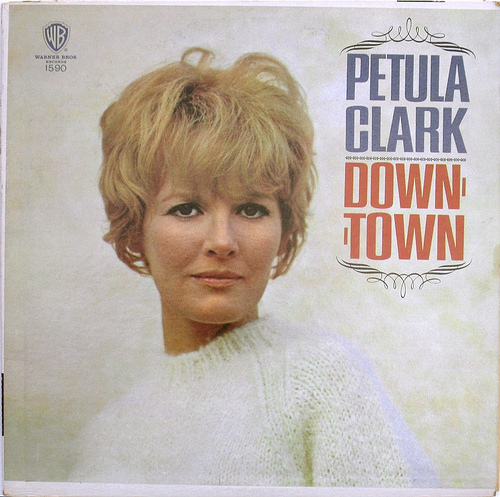
I happened to come out of work on Gay Street in Knoxville at precisely 4 pm. Crystal blue sky, cool, slight breeze, the blazing emerald green of early spring and the downtown clarion bells were playing an elaborately melodic version of Petula Clark’s 1965 hit, “Downtown,” which I include for its poetic perfection. It really was wonderful to be downtown, even if I had to leave early to walk the dog and do some of that writing stuff.

Downtown

When you’re alone and life is making you lonely
You can always go – downtown
When you’ve got worries, all the noise and the hurry
Seems to help, I know – downtown
Just listen to the music of the traffic in the city
Linger on the sidewalk where the neon signs are pretty
How can you lose?

The lights are much brighter there
You can forget all your troubles, forget all your cares
So go downtown, things’ll be great when you’re
Downtown – no finer place, for sure
Downtown – everything’s waiting for you

Don’t hang around and let your problems surround you
There are movie shows – downtown
Maybe you know some little places to go to
Where they never close – downtown
Just listen to the rhythm of a gentle bossa nova
You’ll be dancing with him too before the night is over
Happy again

The lights are much brighter there
You can forget all your troubles, forget all your cares
So go downtown, where all the lights are bright
Downtown – waiting for you tonight
Downtown – you’re gonna be all right now

[Instrumental break]

And you may find somebody kind to help and understand you
Someone who is just like you and needs a gentle hand to
Guide them along

So maybe I’ll see you there
We can forget all our troubles, forget all our cares
So go downtown, things’ll be great when you’re
Downtown – don’t wait a minute for
Downtown – everything’s waiting for you

Downtown, downtown, downtown, downtown …

Tagged with:
Posted in WWWS

Sara’s arancini

Here is the arancini recipe of my mother-in-law, Sara Conti. Like many great intuitive cooks, much of what she does is by look and feel. But this is what she says she always does and the arancini are always wonderful. The recipe makes about 20. The smaller the better, since there’s more taste of the filling. You should be able to hold them inside your hand, about the size of a tennis ball.

Ingredients:

For the rice
I kilo (about 2 lbs) of rice for risotto, cooked al dente
1 stick butter
8 oz grated Parmesan
2 beaten eggs
4T tomato sauce
Mix together in large bowl.
Filling
Prepare the fillings in separate containers.
Pkg of green peas, cooked slightly
1 lb ground beef, sauteed or 100 grams of prosciutto crudo
1 ball of mozzarella
“Some” tomato sauce (i.e. about 1 T for each ball).
Assemblage
Put “some” rice on your outstretched hand. See my last blog for illustration. Now you (or your assistant) put about a rounded teaspoon of each filling ingredient in the middle of the rice, add 1T of sauce (her magic “glue”) and deftly form the ball around it. Sorry, I can’t help you here with the technique. Sara says it works. Be patient.
Coating

  • Flour
  • 2 beaten eggs
  • bread crumbs

Roll each ball in the flour, then egg, then bread crumbs to cover completely.

Frying
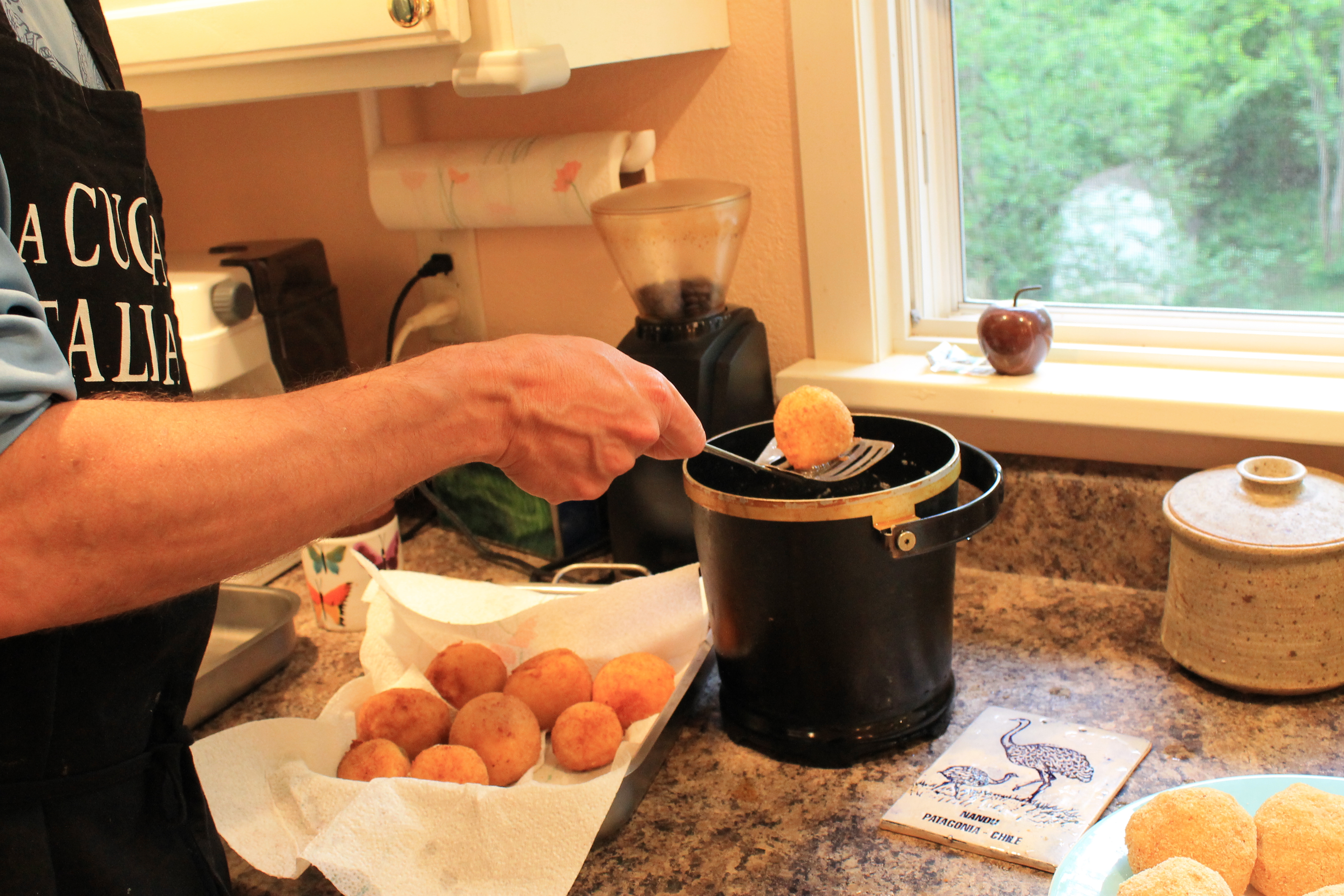
Deep fry in vegetable or other light oil. We used a “Fry Daddy.” Your goal is golden oranges, like the picture. Drain, cool and eat, thinking of Sicily.

Tagged with:
Posted in WWWS

Making arancini

Arancini, or fried rice balls (literally “little oranges”) are a Sicilian wonder. My mother-in-law, Sara, from Licata on the southern coast of Sicily, is a master. You’d think that fried rice balls would be heavy, but not hers. They are like golden oranges, tender and delicious. Inside there are treasures of peas, mozzarella, with prosciutto or ground beef. The rice is tinted with tomato sauce and made slightly sticky with egg, butter and grated Parmesan. You form the rice around the treasures (skillfully, deftly, etc). Then each is dipped in flour, then egg, then bread crumbs and deep fried. When we go back in the summer, Sara always has arancini ready. When Sicilians who have moved to the “mainland” (Italy) go home to visit, buying the true arancini after stepping off the ferry in Messina or airplane in Palermo is a treasured rite of return.

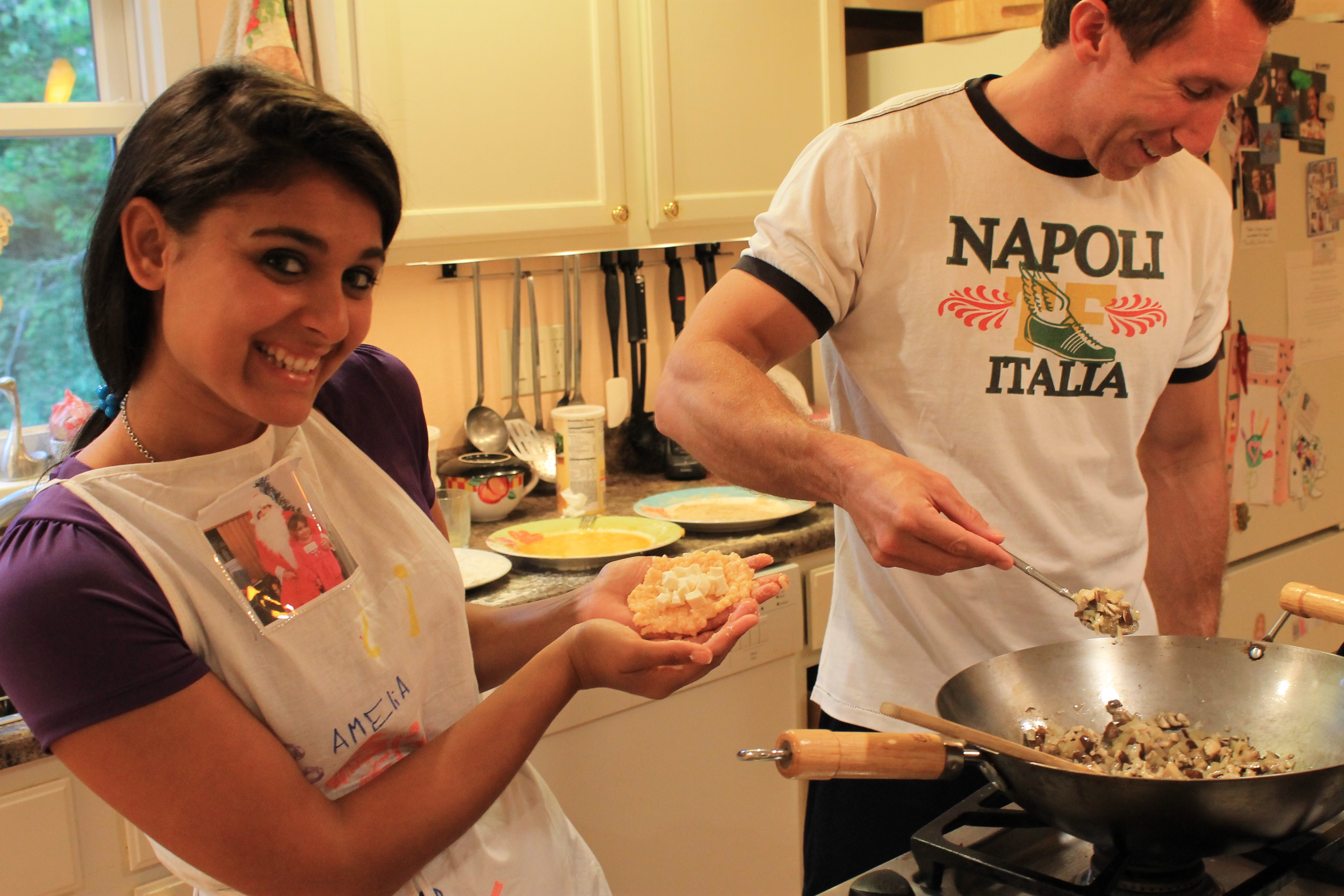
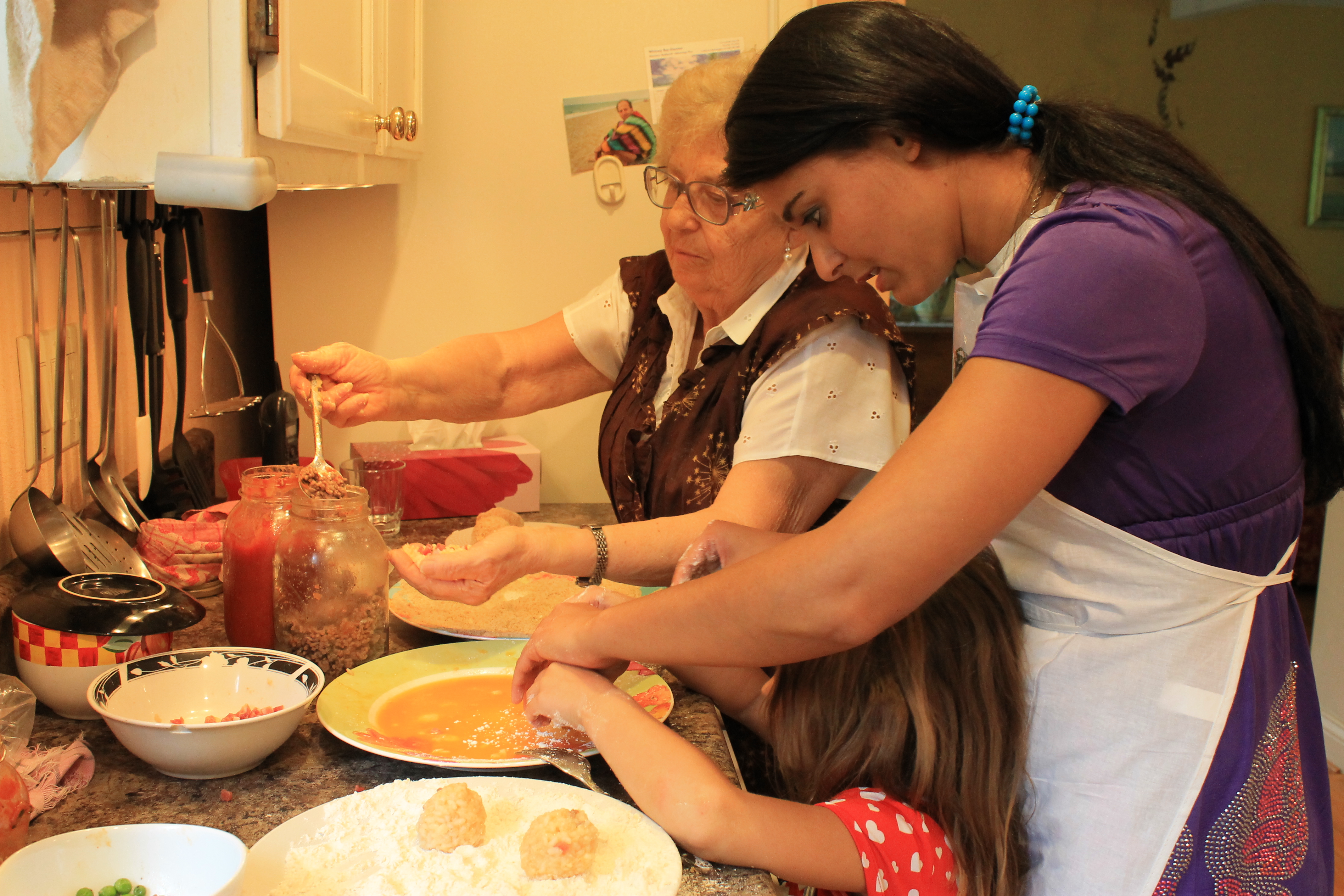
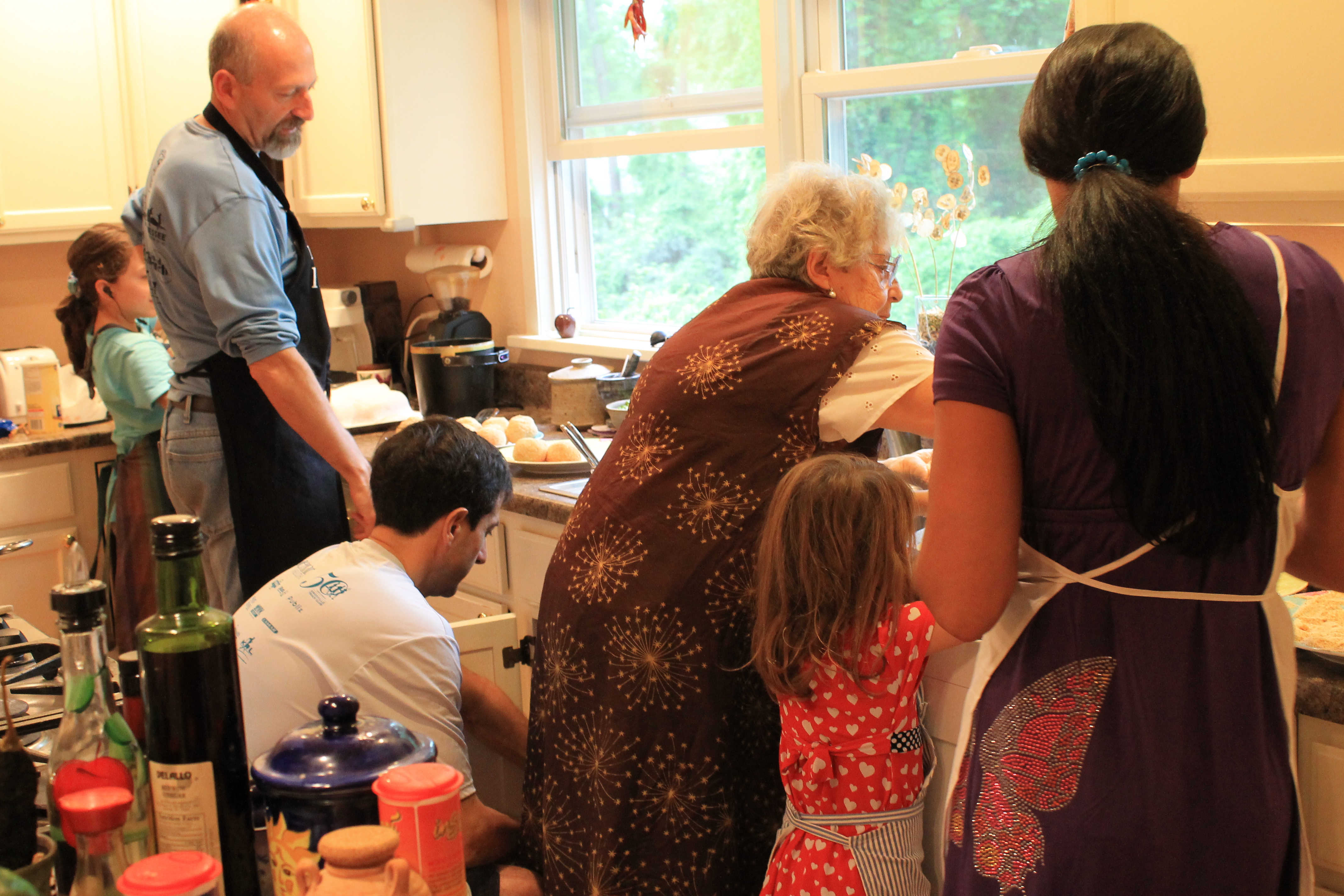
Sara, my brother-in-law Massimo and his daughter Marta are visiting us in Tennessee and making the arancini took everybody’s hands and help. Burrowing in and around the cooks to make this record, I felt as if I’d entered an American stereotype of an Italian kitchen. And there is a lot to be said in its favor. As you can imagine, the arancini were delicious.

Here you see our daughter Emilia demonstrating the rice-with-filling stage with boyfriend Brett who is not Italian, despite the t-shirt, but was game for “the rice ball party.” Then there is the multi-generational coating process, the frying and the final evaluation by esteemed food critic, Silvia, age 5.

In another blog I’ll give  the recipe. Sara is making lasagna right now, so it’s not the time.

Tagged with:
Posted in WWWS

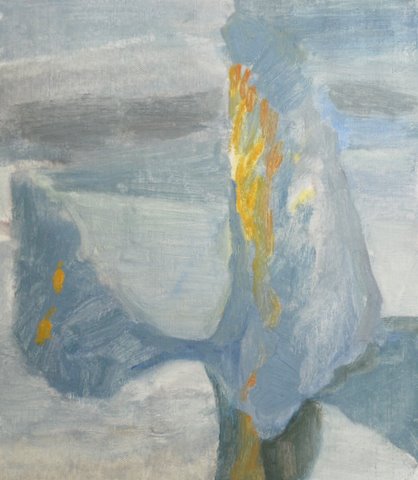
My Iceberg

My Iceberg, © J. Appleton, 2012

Hello again. I realize I haven’t posted in awhile, between rewriting the first chapters of the new novel and hosting Maurizio’s mother, brother and niece (more on our adventures in the next post). But I want to share a beautiful iceberg with you. Happened this way.

Some years ago, when I was between colleges and living in New York, I worked in the Rockefeller Foundation reference library, checking out credentials of the many scholars who wanted grants (not the absolute lunatics who wanted money — they got a form response). In the next department was my new friend Judith Appleton, a fine photographer and artist who generously and vainly tried to get me involved in the visual arts — drawing, block print, silk screen — for all of which I had no talent at all. Later I moved to Ohio, she to Israel and we lost touch. Just recently, through the power of internet, I found Judith in Jerusalem, doing wonderful landscape art. Recently she took a painting vacation in north Greenland (doesn’t everybody?) and shared this beautiful and evocative work, part of an iceberg series. So I share it with you.

Tagged with:
Posted in Just life
Recent Review
“Absorbing and layered with rich historical details, in Under the Same Blue Sky, Schoenewaldt weaves a tender and at times, heartbreaking story about German-Americans during World War I. With remarkable compassion, the author skillfully portrays conflicted loyalties, the search for belonging, the cruelty of war, and the resilience of the human spirit.”—Ann Weisgarber, author of The Promise and The Personal History of Rachel Dupree

Enter your email address to subscribe to this blog and receive notifications of new posts.

Join 122 other subscribers