
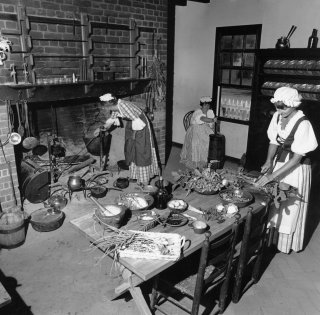
 A couple weeks ago, I was visiting my high school friend Monique for a book reading at her fabulous library in Franklin (see blog “Writing Your Ancestors in Franklin, MA”) We went to Old Sturbridge Village , a restored colonial settlement, or as Maurizio would put it, “a hut museum.” And there, watching a young woman chatting knowledgeably in front of an open fire, bustling about as she showed off herbs and sample meals and how to cook dumplings and prepared to make an apple pie with dried apples reconstituted in cider, I learned:
1. Back then, people had to eat 5,000 calories a day because of all this hard work reconstituting dried apples and plowing and planting and weaving and praying hard and penning tracts against Mother England.
2. Deforestation was so intense that log cabins were impossible to make and most houses had only clapboard. Very very cold.
3. If you had a couple cows you could keep a pig because the pigs ate cheese by-products. Who knew?
I asked what turned out to be the “everybody asks” question: Didn’t people get burned messing around open fires? Didn’t children get scorched? Well no, because:
1. You learn not to back into a fire.
2. The tight, long aprons push your skirt backwards when you bent over an open fire.
3. Natural fibers are less flammable.
4. They dressed little children in raw wool that had lanolin oils resistant to flames.
I had been worried about Irma getting burned while cooking over her open fires. As my sister would say, I can take this off my worry list.

Pamela Schoenewaldt, historical novels of immigration and the search for self in new worlds: WHEN WE WERE STRANGERS, SWIMMING IN THE MOON, and UNDER THE SAME BLUE SKY (all HarperCollins).
 pamelaschoenewaldt.com
Leave a comment