Inventing the past

Charlene Giannetti, reviewing this novel in Woman Around Town, says that Irma’s story allowed her to imagine her own grandmother’s immigration from Southern Italy, for her grandmother would not or could not share the specifics of her journey. I think that for many people, there was some trauma in the immigration experience, at the least the pain of leaving home. Some may have been leaving a difficult situation that pained them to recall. Others may have been simply swept up in the raw newness of America. And some invented an immigration story to fill other needs in their soul. Charlene’s generous sharing of her grandmother’s silence ironically connected with my own grandmother’s elaborate “remembering.”

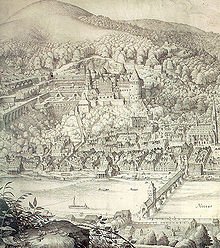
I was four when my German grandmother died. I barely remember her, but my father recounted her own tale, a pure romantic tragedy. The story goes like this. A young nobleman in Heidelberg falls deeply in love with a beautiful servant girl and despite his parents’ furious objections, runs away with her to a tiny country town where they have a child, Carolina, my grandmother. The young man dies and his wealthy parents, having no other heir, gain possession of the child, forcing her mother to become her own daughter’s laundress in the grand house in Heidelberg. Bolstering this story, my grand mother recounted gorgeous ball rooms, crystal chandeliers, soldiers bedecked with gold braid. But the bereft mother can not endure this situation, hears of a family going to America and arranges a deal: they will take the child, kidnap her, essentially, and when the mother has enough funds, she’ll come to America and reclaim the child. And so, at four years old, the child comes to America. A few years later, the mother arrives but can not find the family. They have moved and left no address. They have fallen in love with the child and tell my grandmother nothing of her true past, in fact insisting that all her memories are merely dreams. The grief-stricken mother searches for her lost daughter until the end of her days, finally dying in New Jersey.

The problem is this sad, romantic story is almost certainly invented. My grandmother was indeed adopted, but the noble origins, the country idyll, the mother-turned-laundress and tragic, Evangeline-like search were embellishments, I think, of my grandmother’s longing as she lived her adulthood in a modest house on Brooklyn’s Avenue P. The distance from the Old Country, the clean break between the two worlds allowed some to conjure a new past.

I wonder if this is a unique story, if other families have immigration histories that are more accurately romantic fictions. Let me know.
Tagged with:
Posted in WWWS

Children in the mines

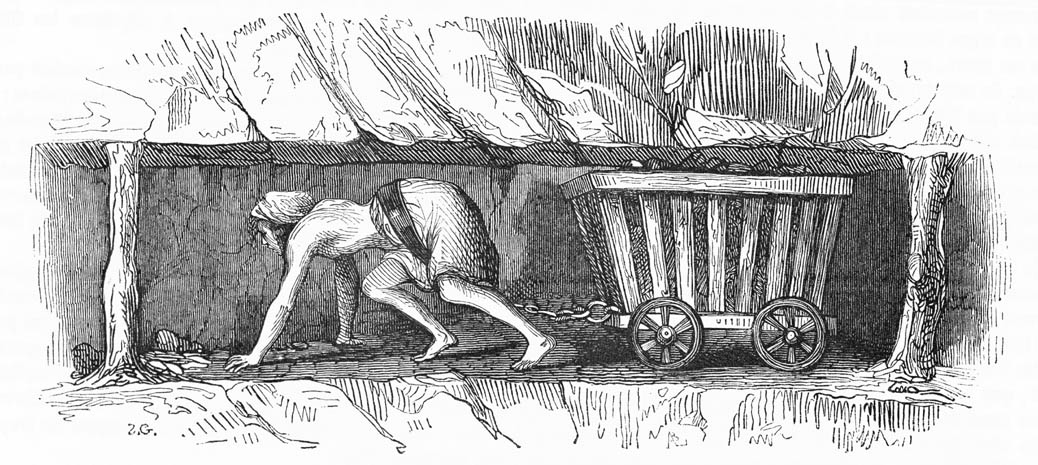
Irma is horrified by Madame Helene’s report of children in the mines of Alsace. Here is an image of a girl pulling a coal wagon. In Victorian England, she was a “putter” and the wagon a “hutchie.” Child labor in the mines of Alsace was not outlawed until 1903. The image of the “little trapper” is from the American coal fields. This is a short post because there is not much to add to these pictures except to note that the unions so vilified today helped stop this practice.

Tagged with:
Posted in WWWS

My grandfather’s grandmother

My grandfather was born in Ohio of a German mother and a father whose mother was Native American. He rarely spoke of her and from the tiny bits of story he let slip, I created this portrait:

My grandfather’s grandmother was Chippewa. She wore hides. She ground Iowa corn. Dark, sticky blood of deer flowed over her hands. Black hair streamed loose behind her as she ran. I imagine this, for no letters, name or photograph remains. When I stalked my grandfather for stray words of her to braid them in a thicker tale, he said, “I’ve already told you what I know.”

I know that her people had rich, watered land, but they stayed too long, watching it fill with strangers. At first pale men came alone to hunt, drink, die or wander west to the emptiness. The Germans were different. They came in flocks, waving papers, making signs, “See?” They said, “The land is ours now.” They chased the deer away, cut high grass to black earth, ripped open the land and planted wheat. Perhaps she watched from thickets one man solemnly scratching arrow rows in dirt, perplexed by his toil. Didn’t he know how simply abundant food could be plucked from bushes, scooped from streams, whistled down from trees? Why trade grain for cloth if soft hides could easily wrap the body? Yet still she must have been uneasily drawn to his straight-arrow world and he to her wildness. They met at the fringes of his fields, found a way to speak and began to fall in love.

“Why him?” her tribe demanded.

“Traitor!” said his. “Have we come so far and worked so hard, tearing out grass to grow our food in rows that you must bring in dark disorder, hair unbound and a savage tongue to call down beasts on us?”
So he took her north to Canada where they both were strangers. He became a carpenter, working in town. She learned German, copying his sounds as once in her warm summers she copied bird songs until only the owl discerned a human accent in the highest trill. Patiently, he molded her tongue with kisses, warmed her at night with new words, waiting until his ears discerned no difference in their speech. Then he bought her dresses, ribbons, corset stays, light powder for her cheeks and pins to loop her hair in curls. They hoarded coins as her people once hoarded corn over long winters. At last he brought her down to another Iowa town where he no one knew their story and all cautiously admired his elegant, black-haired woman. He built a house for her beyond the last roads, where the grass was still uncut.

But my grandfather’s grandfather and this woman had been too long alone together. Their ears no longer caught the feather-edge of strangeness in her words.

“She’s no German,” the women whispered. “Listen to her. Look at her skin. She’s one of them.” Then my grandfather’s grandmother feared that for this feather-edge she would lose her home again. But her lover did not flinch.

“She’s Polish,” he insisted. In the way of small towns and because they needed a carpenter, they left his lie alone and did not ask again. In time they made room for “the Polack” in the land of her people. They helped her cook their stews and bread and adjusted her clothes and speech to be more like theirs. She, for her part, was careful to never make her people’s food again, speak her own language to her babe or call down birds. Only at night, holding her, did my grandfather’s grandfather hear laments he did not understand, cherishing her strangeness, familiar as no other.

Their son grew into dark, hard man with a thin, hooked nose, for which sign he hated his mother and took care to import a pure German girl who soon betrayed him, learning the English he would not speak. So he became the foreigner, never tuning his heart to the wild strangeness, the new language of any love.

Tagged with:
Posted in WWWS

Beyond Torta Caprese

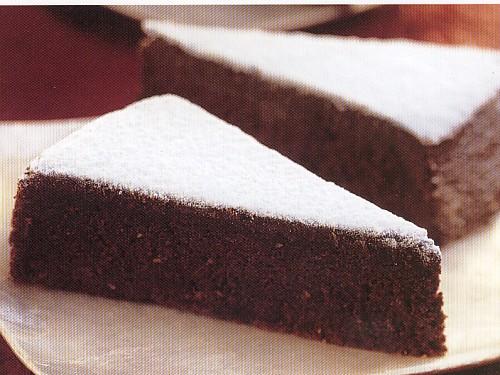
The Irma of my novel lived a half-century before the probable dawn of Torta Caprese, the dense and delicious flourless chocolate cake whose link with the island of Capri is more gastro-hype than real. Most likely Irma never tasted chocolate until she came to America. But that was then.

In honor of a giveaway sponsored by Mirella Patzer’s Historical Novel Review blog, here’s a recipe for Torta Caprese, a frequent finale at our house. I always add a non-traditional embellishment, but nobody seems to mind, there being little to mind in Grand Marnier.

Torta Caprese
Preheat oven to 350 and butter a 10″ springform pan. Line bottom with parchment paper.
Ingredients:
1 1/2C blanched slivered almonds
1 C sugar
8 oz bittersweet chocolate
5 large eggs, separated
1/2 tsp (or a little more) almond extract
1 tsp grated lemon peel
1/2C melted unsalted butter
pinch of salt
confectioner’s sugar

Combine almonds with 1/3 C sugar in processor until very fine. Dump in large bow. Again in the processor (you don’t need to clean it) process chocolate and 1/3 C sugar until the chocolate is finely ground. Add to almond-sugar and mix well until the color is uniform.
Melt and cool butter. Meanwhile, in separate bowl, with electric mixer, combine egg yolks with sugar until thick and foamy. Add egg mixture to the chocolate-almond-sugar mix, then add almond extract and lemon peel. Add melted, cooled butter and mix well.
With clean, dry beaters, beat egg whites with salt until stiff but not dry. Add to chocolate mixture in three additions, folding in carefully. Your goal is that the mixture be reasonably uniform without deflating the egg whites. Pour into prepared pan, smooth, bake. Check at 35 minutes with cake tester. Some crumbs may cling, but the center shouldn’t be wet. You may need to give it a few more minutes. Cool about 10 minutes before removing sides.

Decoration: When cake is cool you may dust with confectioner’s sugar. You can just use a sifter. However, I often make a simple stencil, maybe an initial of the guest of honor (or the cook), or something else. I’m not that good with scissors, but you can be fancy if you like.

Stop here if you want the classic Torta Caprese. But you may also offer . . .
some rich vanilla ice cream on the side. . . and/or . . . as in Italian, “crepi l’avarizia” [death to prudence and moderation]:

Raspberry Grand Marnier Sauce
10 oz frozen raspberries
4 T sugar
1 tsp corn starch
1-2 T Grand Marnier
juice of 1/2 – 1 lemon
Put frozen raspberries in saucepan. Add sugar and cook over low heat until berries are thawed and sugar melted. Put some juice in a small bowl, add cornstarch, combine, and put back in saucepan. Cook a bit until thickened. Cool and add Grand Marnier and lemon.

Pass with the cake. Your friends will be happy.

You can be happy again at breakfast if you have leftovers.

Tagged with:
Posted in WWWS

Being an immigrant in Naples

My historical novel of immigration, When We Were Strangers, is set in the 1880s, when Irma Vitale leaves her mountain village in Southern Italy and comes to America. My “research” began in November, 1990, when I left Northern California to live in Naples, Italy with my fiancé, Maurizio, and felt the searing displacement that might have been Irma’s.

I’d been to Italy as a tourist on the customary circuit. Nothing of those sunny easy days prepared me for life in the center of Naples. I had worked in California as a freelance writer with some success. In Naples I could barely frame a sentence. Shopping, the gay experience of so many American-in-Italy films, was complex. “You bombed this!” one man said accusingly, pointing to a church damaged by the Allies during World War II. I went to school in the morning and food stores closed in the afternoon, opening on what seemed a secret schedule. When could I shop? The discovery that food stores don’t open at all on Thursday afternoon threw me into a fuming rage, an overwhelming passion to shop for groceries on Thursday afternoons.

Tense and frustrated, I got tangled up in verbs and participles. On vacation, it could be fun to point and playact and muddle along in a new language. Since I was living here, I wanted to be perfect, at least grammatical. And of course I wasn’t, far from it. “Relax,” said Maurizio. But I couldn’t and wasted time learning words of limited utility in the present circumstances: “cianura” — cyanide, and “defenestrazione” — killing people by throwing them out of windows.

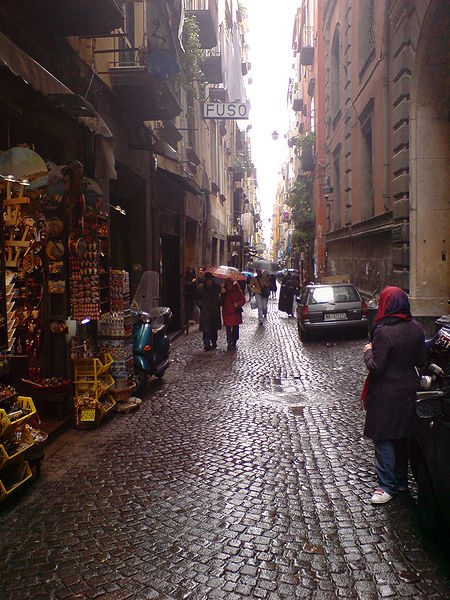
November was cold and rainy; our apartment unheated. We lived in coats. In the old quarters of Naples, roads are paved with basalt; buildings climbing overhead were dark with age, opening to slits of gray sky. No parks, trees or grass. I knew that in a walled medieval city, parks are an unreasonable luxury, yet I ached for California’s green.

“It’s a small apartment,” Maurizio had warned before I came to Naples. No kidding. We had a basso, two rooms on the ground floor of a vicoletto, an alley perhaps 12 feet wide, paved in the eternal basalt, in constant shadow. Our front room had one “window,” an opening to the vicoletto about 18 inches square, lined in black marble a foot deep. That would be our refrigerator. We parked Maurizio’s motorcycle inside for safety. Our hand-washed clothes dried with painful slowness here too, for they would be stolen if hung outside. Our bedroom had no window. Frequent power failures left it pitch dark. But of all these inconveniences (soon over for we had moved by Spring), the worst was to feel so foreign, awkward and ignorant. After some social or linguistic gaffe, or frustrated by the seeming complexity of each new enterprise or bureaucratic affair that left me feeling childishly incompetent, l wanted to say, “In my country, I know the rules.”

Tagged with: ,
Posted in WWWS

“Is this your first day?”

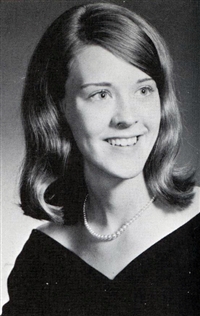
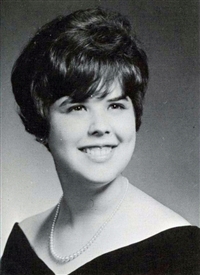
An unexpected pleasure of publishing a book is connecting with old friends. When I was 14 (see image, left, long hair) we moved perhaps 15 miles away to another New Jersey bedroom community. Fifteen miles might as well be another country in HighSchoolLand and there I sat, quite alone in my silly green gym clothes as the PE teacher explained Rules & Regulations and I’m thinking that the rule at Watchung Hills Regional High School was that nobody would ever talk to me. When we were lining up for leg lifts or laps around the gym, Ellen Weiss (below, short hair) scooted over and said the words that every new kid longs to hear, body and soul: “Is this your first day? Do you want to sit with me in the cafeteria?” That kind of welcome gets you through a lot of dark teenage days. In a couple weeks I’ll be going to Maryland to share my book with Ellen’s book group. It will be great. And we don’t have to wear silly gym clothes with our names embroidered over the pocket.

Tagged with:
Posted in WWWS

Fates of bustles and sleeves

In the 1880s, as my protagonist Irma entered the world of women’s fashion, machine-made clothes were readily available and upper class women, with money to burn sought out skilled dressmakers to embellish, over-lay, tuck and gather, creating elaborate architectures, often framed around bustles. So we have the famed First or “hard” Bustle Period of the 1870s giving way to the Second or “soft” Bustle Period of the 1880s, both feeding the hips-and-backview fetish of Victorian men and fashionistas. In the 1890s, bustles were out, gone, booted. Now, fashion architects turned to bizarre sleeve structures, with Punch magazine ready with mockery. For more on the bustle, elegantly written, see the lovely site Such Eternal Delight from whence comes this illustration.

Tagged with:
Posted in WWWS

Shrinking the Golden Gate

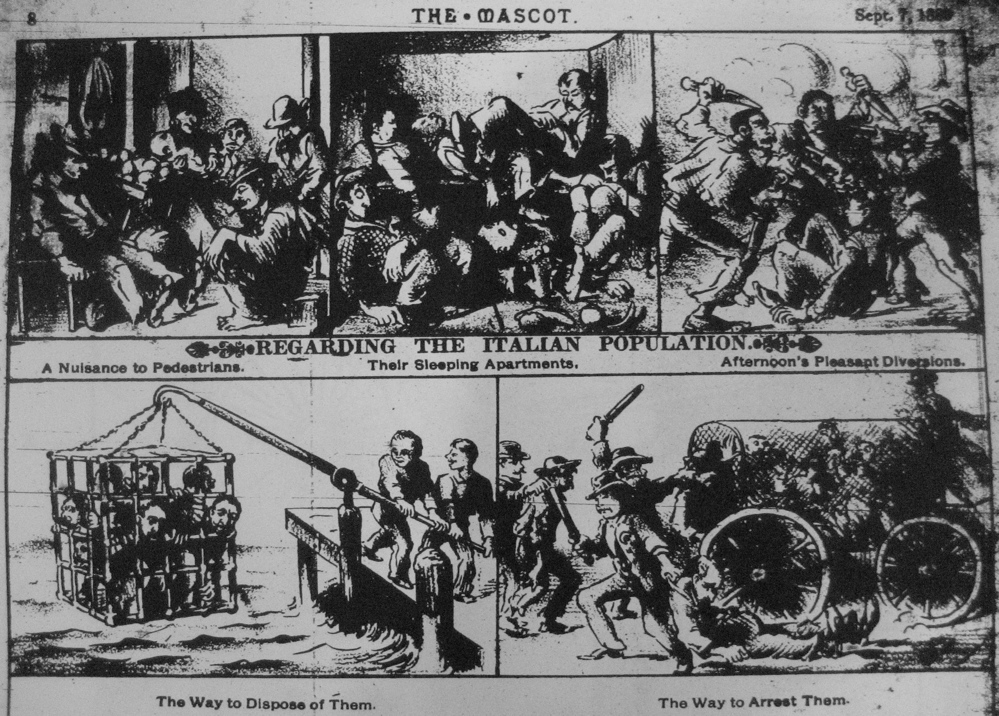
When We Were Strangers is set in the early 1880’s. A few years later, rising immigration from Italy began to unleash what now seems astonishing, rabid anti-Italian prejudice of which this cartoon is, believe me, a relatively mild example.

In 1909, a Senator Henry Cabot Lodge proposed a frankly racially-based immigration restriction: “The illiteracy test will bear most heavily upon the Italians, Russians, Poles, Hungarians, Greeks, and Asiatics, and very lightly, or not at all, upon English-speaking emigrants, or Germans, Scandinavians, and French. In other words, the races most affected by the illiteracy test are those whose emigration to this country has begun within the last twenty years and swelled rapidly to enormous proportions, races with which the English- speaking people have never hitherto assimilated, and who are most alien to the great body of the people of the United States.”

The idea of a merrily bubbling melting pot seems to have existed only in scattered moments of our history.

Tagged with:
Posted in WWWS

Valley of Lost Cauliflowers

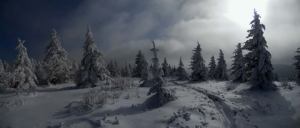
Today in the snowy valley of Canaan (locally: ka-NAN), West Virginia, Maurizio cross-country skis the miles of groomed trails at White Grass resort and I’m in our apartment with a sprained wrist, writing slowly. Cross-country seems to be a sport woven into my writing life, not because I’m good at skiing. On the contrary. On a cross-country weekend in Opi in Abruzzo, avoiding the slopes to wander the town, I had the first inspiration for my novel. Last year in this resort my overriding obsession was making lists of possible titles for the finished work, already under contract at HarperCollins. This year, off the slopes, I’m thrown into chapter 3 of my next, medieval venture.
For most of every winter, the Canaan Valley wears a thick white blanket, rimmed with soft hills laced with wide trails, originally logging roads, now repurposed for skiers. But in the ’40s and ’50s the white was cauliflower. Ruthlessly lumbered for red spruce in the 1800s (“We didn’t leave a stick standing,” boasted one logger), the land lay abandoned until tons of imported topsoil briefly turned cool, moist Canaan into America’s caulilflower cradle. That didn’t last. Deer devastation and a bud-destroying insect ravished the crops. Now Canaan’s natural resource is snow, abundant and powdery and visitors to the Canaan Valley State Park, highest valley east of the Mississippi, already ancient in the Pleistocene. [photo from whitegrass.com]

Tagged with:
Posted in WWWS

Launch day!

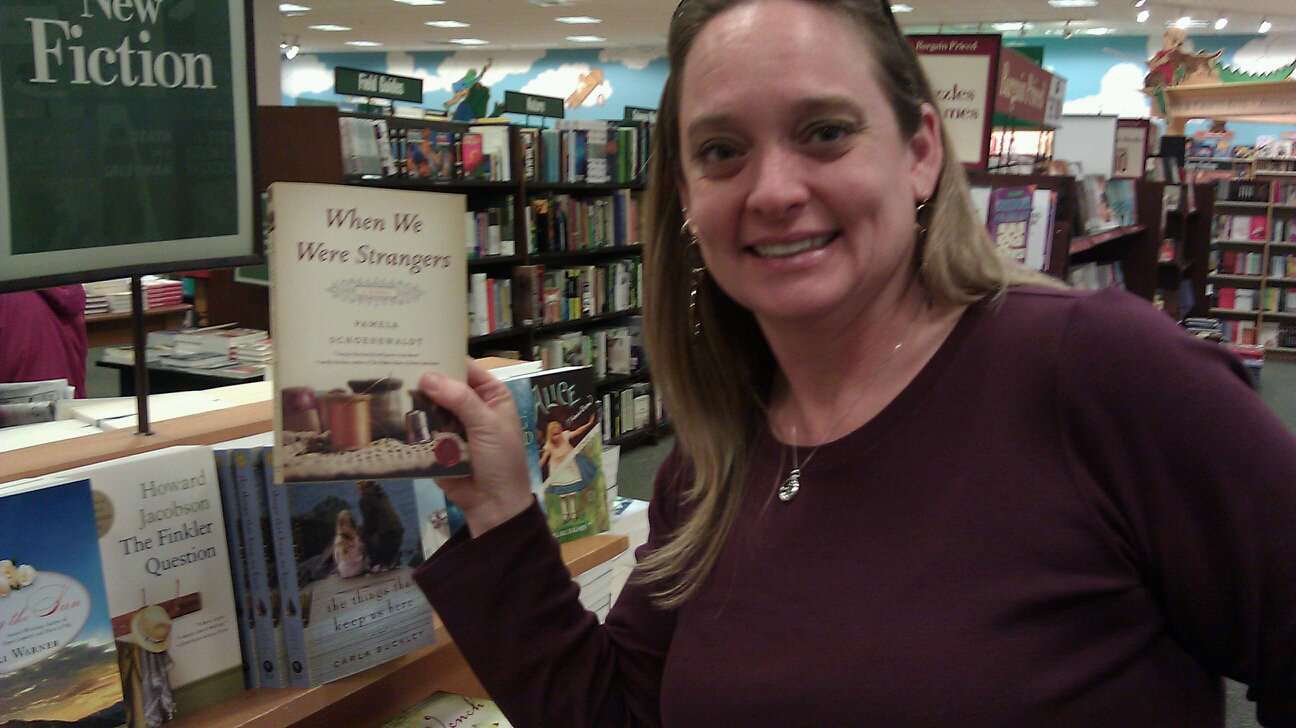
Here is my wonderful friend Emily Dziuban of Charleston in Barnes & Noble with the book! And here also a send from Karl Rice, a former student of my Naples years, with a Las Vegas book store marketing innovation. It seems so magical, not just the creation of the object from the long-ago inspiration, but the system. Book produced in Knoxville, publication managed in New York, and now Emily has it in a SC and in Ghana, a haiku poet spoke to a blog review on how little progress we’ve made in compassionate discourse on immigration. I know, I know, this is connectivity 101, but it’s stunning to me in this context. What would Irma think of all this technology, all this sending and posting? She’d be bemused, I think.

Tagged with:
Posted in WWWS
Recent Review
“Absorbing and layered with rich historical details, in Under the Same Blue Sky, Schoenewaldt weaves a tender and at times, heartbreaking story about German-Americans during World War I. With remarkable compassion, the author skillfully portrays conflicted loyalties, the search for belonging, the cruelty of war, and the resilience of the human spirit.”—Ann Weisgarber, author of The Promise and The Personal History of Rachel Dupree

Enter your email address to subscribe to this blog and receive notifications of new posts.

Join 122 other subscribers