The boarding house reach

Both my first novel, When We Were Strangers, and my current one (coming in September, 2013), put the main character for some time in boarding houses in the years between 1880 and 1911. So I did some research and find these fascinating institutions that served many purposes.

Young men and women were coming from farms and rural areas to the big American cities. Private housing was expensive and solitary in a new and overwhelming places. Boarding houses received them and provided an instant family. Immigrants found small enclaves often of their own nationality, something like the villages they’d left. Young working women could live respectably, often with some oversight by the landlady and companionship of other boarders.

There were houses that catered to men, to women, to ethnic groups, to those who kept kosher and to members of various trades. They came in all price ranges. Keeping a boarding house gave respectable work to widows who might not otherwise have been able to maintain themselves or keep a home they’d managed with a husband’s income.

There was a necessary regimentation: meals were served at fixed hours. Too bad for latecomers. Bathrooms were shared. Rent must be paid. There was little privacy. But around the big table and in the parlor at night, the city worker found company and a semblance of home.

In the 19th C, the words “family” and “household” were often used interchangeably. In a fluid time, the boarding houses offered home to the rootless, the newly arrived, the seekers, the ambitious, and those in transit to new lives in new worlds.
Note: The dark-haired man in the illustration is Abraham Lincoln who lived in boardinghouses in Springfield, Ill. before he married Mary Todd.
Tagged with:
Posted in WWWS

Dickens & Little Red Riding Hood

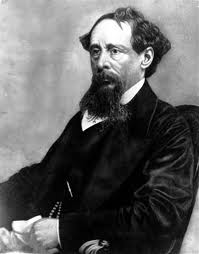
The New York Public Library has an exhibit on characters of Charles Dickens, including illustrations, notes, merchandising (he was very into this) and some astonishing quotes. Like this one: “If I could have married Little Red Riding Hood, I should have known perfect bliss.”

Hum, Readers all, shall we parse this? Charles Dickens wanted to wed Little Red because:

Younger is better?
He had a thing for hoods?

  • Gullible is good?
  • Distracted is good?
  • Not listening to instructions leads to bliss?
  • Girls so myopic they can’t tell the difference between wolves and grandmas are just so adorable?
  • Little girls in red are especially tasty?
  • The never-real are always better?

Whatever did Mr. Dickens mean? And do we want to know? Ideas?

Tagged with:
Posted in WWWS

The terror of Sherwin-Williams

My office at work is being painted. The paint brand is Sherwin-Williams and suddenly I am thrown back to me at age perhaps six, just able to read. A hardware store on Main Street in Metuchen, N.J. has a sign with the Sherwin-Williams logo that tormented my childhood with questions I was afraid to pose to my father who knew pretty much everything. Perhaps he’d think these ridiculous questions:
Was there really a paint can that big somewhere over the North Pole?
How much paint would it hold?
Would the paint come down as far as New Jersey?
Could we outrun it?
Who will tip it?
Red like blood?
Wouldn’t gravity hold the drops?
Will the mountains be covered, like in Noah’s flood?
Why aren’t other kids scared? Why only me?
Finally I believe I asked my mother if the picture was “real.” I’m thinking she thought I was asking if the logo was real. “Yes,” she said, “of course it’s real.”
The innocence of childhood is shot through with terror.

Tagged with:
Posted in WWWS

Communion, with squirrel

Taking communion today, I flashed back to a conversation with a guard in a museum in Spoleto, in the center of Umbria, the green heart of Italy. It involved squirrels and happened like this. I was in a writing program and (not writing)  went with friends to a museum there, probably the Museo Diocesiano. A large 16th C fresco portrayed the Last Supper. Forget a spartan meal of bread and wine. Here were heaping platters of fruits, dried and fresh, nuts, grapes, vegetables of all sorts. We talked a bit about Umbrian abundance but couldn’t help noticing that ceremoniously in front of Jesus was a platter of . . . roasted squirrel. No bushy tail, of course, but no mistaking the little pointed face and paws sticking up. Jesus is pointing to the roasted beastie with a gesture that clearly means more than “Yum, squirrel, my favorite. Thanks, guys.”  Since I was the only one of the company who spoke Italian I was dispatched to find a guard and come back with the Word on Squirrel.
With some difficulty I found a guard reading a newspaper, clearly not in the mood for art explication. With a long sigh, he put down his paper. Yes, he did know the fresco of the Last Supper on the second floor. Yes, there was a roasted squirrel set in front of Our Lord.
Me: But, sir, why is that? There were no squirrels in Palestine.
Guard: (sigh) No? Well there were many squirrels in Umbria in the 16th Century.
Me: Yes, also in my country and they are sometimes eaten, but Jesus is pointing to the squirrel  in this fresco.
Guard: Of course. (Looking at me as quite the dense of the dense, one who has no business in an art museum. Big sigh). Signora, you are perhaps aware that Our Lord is often represented as the Lamb of God?
Me: Yes, I know.
The guard snaps open his newspaper, explication done. I don’t move. Finally he looks over the paper at me. Puts it down. Really! These Americans, culture imbeciles.
Guard: So would it not be disgusting to have a whole roasted lamb on the table, right in front of Our Lord?
Me: I suppose so.
Guard: So . . . the artist used a squirrel.
Now the guard is really finished with me. He opens the paper with clear finality and wishes me further enjoyment of the museum. Trekking back to my waiting friends, I laboriously put together the pieces of this little lesson. A roasted squirrel (sans tail) does (sort of) look like a roasted lamb, which reminds us of the Lamb of God. So there we have it, as any fool can see, the Blessed Squirrel that taketh away the sins of the world.

Tagged with:
Posted in WWWS

The infidelities of Spell-Check

In going through some papers of my college teaching years, I came upon a handout which I innocently thought would be enough to warn students out of blind faith in Spell-Check. Alas, faith is hard to shake. Here is the first paragraph. Read aloud and see what you get:

Ladle Rat Rotten Hut
Wants pawn term, dare worsted ladle gull hoe lift wetter mutter inner ladle cordage honor itch offer lodge, dock florist. Disc ladle gull orphan worry ladle cluck wetter putty ladle rat hut, and fur disc raisin, pimple caulder Ladle Rat Rotten Hut. Wan moaning Ladle Rat Rotten Hut’s mutter set, “Heresy ladle basking winsome burden barter end shock her kook keys. Tick disc ladle basking tudor cordage offer groin mutter honor udder site offer florist. Shaker lake, dun stopper laundry wroter, and yonder nor sorghum stenches shooed jew stopper torque wet strainers.”

Tagged with:
Posted in WWWS

Writing at the Lake

We went to a friend’s house last weekend at Laurel Mountain Lake, near Sweetwater, Tennessee. As you see: water, sky, peace. No phone, TV or internet (and I don’t have a fancy phone so really no internet). It is astonishing how many pages a person can edit in those circumstances. Pages and pages, chapters and chapters, and still time for walks and for naps after lunch. I also planned six (6) presentations for my trip this week to Hiram College, where I graduated an unnamed number of years ago and where I’ll be delivering “yes you can” talks to young writers.

We went canoeing each day with Jesse the Dog who used to have to be hauled in but now, perhaps out of fear of being left alone, he jumped right in. Peaceful happy hours on the dock, breakfast on the dock, dinners in the near dark of the porch, more editing. One could feast on this life.

Tagged with:
Posted in WWWS

The novelist’s magic tool

Sure, sure, Google does yeoman’s service for the hard-pressed fiction writer, but if a few minutes of banging around on the internet won’t get me to the factoid I need, it’s time to get smart and . . . use a library! Ask a professional. The results are magical. For information on Cleveland, the setting of my novel, I turn to the Western Reserve Historical Society and for almost everything else, from treatments of the mentally ill in 1910 (maybe you don’t want to know) to yesterday’s question, normal speed limits in 1910, I accost my friend Melissa, reference wizard of the Knoxville Public Library.

I got my answer: speed limits, when posted, were 10 mph. in cities (lots of horses on the road) and 20-25 mp. in the country. But as the July 2, 1910 Harper’s Weekly article which Melissa found for me warns, tooling along in the 1910’s had its problems: “Legally there is a speed limit of twenty miles an hour in the country districts; but actually there is no limit with the motor-car, once the driver gets away from the cross-roads so dear to the heart of the country constable, ever on the alert for his emolument. In the open country there are no restrictions upon speed except those that the automobilist places upon himself.” . . .[However] “It is awkward to come upon any of these [pedestrians, animals, other vehicles] unawares at twenty-five miles an hour on a narrow country road flanked by ditches, small trees, or banks impossible to drive over.” . . . “To negotiate successfully such a curve at more than twelve miles an hour calls for quick judgment and a good hand at the steering-wheel….”

Moral . . . If you love to write, love your library.

Posted in WWWS

Odd thoughts on writing

I’m revising today, staring at the screen and perhaps that brings the odd thoughts. For instance:

1. Did it ever strike you as odd that black marks on a page (or screen) arranged in certain ways can bring an emotional, even visceral response? Of course sometimes they can put you to sleep, but at their best, those marks go to the eye, the brain, and move your whole body.

2. Now one could say the same about painting. What’s so special about dots or dabs of color, but there’s nothing inherently beautiful or even visually interesting about typical text on a page.

3. And for revision, isn’t it amazing (and humbling) that you can bring a piece of work as far as you honestly think it can go. As if you’ve brought it to a solid wall. Then a good reader makes a comment, shares an observation — “This makes me feel X” — and slowly a door opens and you see another field you can enter. Or to wildly mix a metaphor, you see how you can go deeper, closer to the bone. You truly couldn’t see that before.
It’s all so amazing.

Tagged with:
Posted in WWWS

What Americans ate in the 1910’s, etc.

Ohh, I just found a wonderful site  called Food Timeline if you’re wildly or mildly curious about what people ate in the 1910’s (my case) or in decades after. You’ll find menus, cookbooks, recipes, prices, new rages, like the “cocktail party,” invented circa 1917 in Saint Louis. New products, regional specialties. So if you have time and inclination, you can plan a 1930’s dinner party for the very rich, or save money on a Depression meal from the Dust Bowl. Anyway, great site for browsing.

Tagged with:
Posted in WWWS

Where do cops come from?

This time travel began some hours ago when I wanted to make sure that my character in 1911 could refer to a policeman as a cop or perhaps a copper. Would this be an anachronism? It’s a lot of work to write a novel and one doesn’t want the effort gone to waste for mistakes like this. So, short answer, yes, the cop/copper terms have been around as slang for police from before 1800. The terms come from Latin capere (to seize) as in capture, although some sources give an Old English root for “to steal.” Anyway, taking something.

Now all this time I assumed the source was copper badges that policemen wore. That’s what my father told me and he knew everything. Or pretty much. He’d read the Encyclopedia Britannica of an evening, or stand for hours at our unabridged dictionary. He’d have me guess if words had Latin or Greek roots at an age so tender I didn’t even really get what “Latin” or “Greek” meant. How could he not be right about cop/copper? In fact, says my source severely, the presumed copper badges connection is a “folk etymology.” This is a blow.

I still think he knew almost everything even if (and this is a digression) he often had age-inappropriate teaching styles. I must have been 9, reading in the living room on a Saturday afternoon while he was taking a nap. The radio gravely announced a man apprehended for rape. I poked my father awake to ask what “rape” meant. “Carnal knowledge of a woman by force and without consent,” he said drowsily.

“Huh?”

“Look it up.” He turned over. Now why should I look it up? I knew all the words in the definition. “Carnal” was about meat-eating and the rest were easy so . . . hum .  . . rape was forcing a woman to learn about carnivores? Or finding out by force that a woman ate meat? This was so bad? Somewhat later, doing my weekly catchup of the “Day by Day With My Bible” Sunday school assignment, I came upon the “and Adam knew Eve” euphemism. So . . . ohhh. . . . that kind of knowledge.

What’s the point of this ramble? Live and learn, I guess. The truth comes out by various means eventually.

Posted in WWWS
Recent Review
“Absorbing and layered with rich historical details, in Under the Same Blue Sky, Schoenewaldt weaves a tender and at times, heartbreaking story about German-Americans during World War I. With remarkable compassion, the author skillfully portrays conflicted loyalties, the search for belonging, the cruelty of war, and the resilience of the human spirit.”—Ann Weisgarber, author of The Promise and The Personal History of Rachel Dupree

Enter your email address to subscribe to this blog and receive notifications of new posts.

Join 122 other subscribers